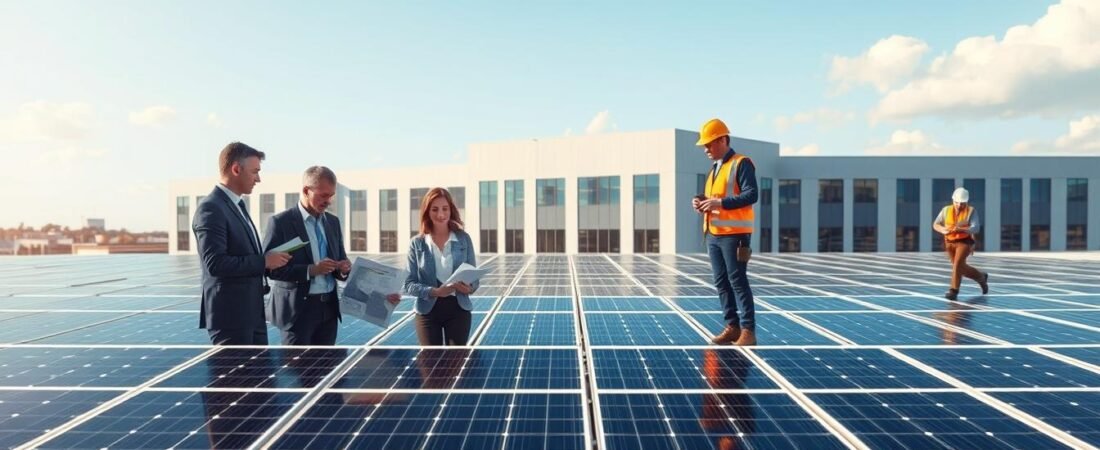
Ready to cut costs and shrink your building’s carbon footprint? This guide walks U.S. businesses through the key steps for a successful commercial solar project. It explains design basics, tax incentives, and how the right system drives long-term savings.
The industry saw a 17% jump in project volume from 2023 to 2024, according to SEIA. That rise shows more companies see clean energy as a smart investment and not just a trend.
Choosing the right approach matters. Every system must match a building’s energy needs to maximize electricity savings and reduce reliance on the grid.
In this guide you’ll learn how to evaluate costs, claim federal tax credits, and pick a reputable company for safe, efficient installations. Use this intro as your quick roadmap to better power and lower bills.
Understanding Commercial Solar Energy Systems
A commercial solar system begins by turning sunlight into DC current and then converts that current into the AC electricity your building uses each day.
Texas Solar Group works with businesses to design the right layout for each property. They match system size to actual energy needs so you get consistent power without waste.
Modern panels are built for durability. Tempered glass and non-corrosive frames protect modules from wind, rain, and hail. That means less upkeep and steady output for years.
- Systems can send surplus electricity back to the grid, often lowering bills.
- Businesses of all sizes benefit from reduced dependence on utility providers.
- Adopting renewable energy also lowers a company’s carbon footprint.
Understanding how these systems work is the first step toward better energy efficiency and lower long-term operating costs for your building.
Key Benefits of Solar Panel Installation Commercial Buildings
Switching to on-site renewable power can cut utility bills and stabilize operating costs for many firms. Below we outline the financial and environmental advantages that matter most to U.S. businesses.
Financial Savings
Installing commercial solar leads to clear cost reductions by lowering the amount of electricity you buy from the grid.
Companies lock in predictable energy rates and protect their budgets from utility price swings.
Tax incentives and depreciation like MACRS further improve project returns and shorten payback periods.
Environmental Impact
Using renewable energy cuts carbon emissions and supports corporate sustainability goals.
Quiet, efficient systems run with low maintenance and help businesses show commitment to the planet. This often boosts reputation with clients and the local community.
“Adopting clean power is both a smart financial move and a visible step toward long-term stewardship.”
| Benefit | Short-Term Effect | Long-Term Effect |
|---|---|---|
| Lower energy costs | Reduced monthly electricity bills | High ROI over asset life |
| Operational stability | Predictable power expenses | Protection from rate volatility |
| Environmental | Immediate emissions drop | Stronger brand and property value |
- Reduced electricity spend: Less grid dependence.
- Reliable systems: Quiet, low upkeep generation.
- Incentives: Tax and depreciation boost returns.
Analyzing the Costs of Commercial Solar Projects
Estimating total project costs starts with a per-watt baseline and careful design. At roughly $1.46 per watt, average pricing gives businesses a quick benchmark. Total spend still varies with system size, roof complexity, and electrical upgrades.
A thorough design phase is essential. Good design matches the system to your energy needs and sets the number of panels required. That directly influences the investment and expected savings.
Federal incentives matter. The investment tax credit can lower upfront costs by about 30%, improving payback for many projects.
Compare financing options before you commit. Cash purchases, loans, and power purchase agreements each change long-term returns. Larger projects often enjoy lower costs per watt thanks to economies of scale.
- Key steps: site evaluation, detailed design, and cost-benefit analysis with a pro.
- Consider: financing options and available tax credits to maximize savings.
| Item | Impact on Cost | Notes |
|---|---|---|
| Per-watt price | Direct | Average $1.46/watt |
| Design & site work | High | Determines system size and output |
| Incentives | Reduces | ITC ≈30% lowers upfront investment |
Factors Influencing Your Solar Installation Timeline
Project timing often hinges on approvals from local authorities and utilities. Understanding the usual bottlenecks helps you set realistic expectations and avoid costly surprises.
Permitting and Utility Approvals
Permits take time. Local permit offices may have backlogs that delay start dates. Plan for extra weeks when you submit applications.
Utility approvals are the other key step. Utilities must sign off before your system ties to the grid. Fast, clear communication with them shortens final approvals.
- Complex projects with thousands of panels need more design, labor, and testing time.
- Site prep — roof repairs, tree trimming, or structural work — adds days or weeks if not ready.
- Weather and crew availability can push schedules; choose an installer who gives a clear project outline.
Tip: Ask your installer for a timeline that lists permit milestones and utility checkpoints. That gives your team a reliable roadmap and helps avoid last-minute delays in the commercial solar installation process.
Essential Steps for a Successful Solar Project
Good outcomes begin with data: structural checks, shade maps, and a utility review set the tone.
Site Evaluation
Start with a thorough survey. Inspect the roof and confirm load capacity. Run a shade analysis to estimate daily energy potential.
Tip: Include electrical service reviews and permit readiness to avoid later delays.
System Design
Engineers create layouts that match energy needs to available roof area. Careful design maximizes electricity yield and minimizes disruption to your business.
Commissioning
Final testing verifies output and safety. The utility then approves the connection to the grid so the system can begin producing power.
| Step | Primary Goal | Who is involved |
|---|---|---|
| Site Evaluation | Assess structure, shade, permits | Engineer, roofer, estimator |
| System Design | Optimize layout for energy needs | Design team, electrical engineer |
| Commissioning | Test performance & safety | Installer, inspector, utility |
Follow these steps and choose an experienced company for the project. For a checklist of key stages, see this key stages.
Exploring Financing and Ownership Options
Financing choices shape both short-term cash flow and long-term savings for any business energy project.
Cash purchases give your company full ownership and let you claim the investment tax credit and other tax credits directly. That often yields the highest lifetime savings.
Solar loans spread cost over time. Monthly payments can be covered by reduced electricity bills, so many firms stay cash-positive from month one.
Power Purchase Agreements (PPAs) let a third party own the system while you buy the generated power. PPAs lower upfront risk but shift some long-term benefits to the owner.
“Choosing the right financing option aligns your capital limits with expected project savings.”
- Net metering credits for excess power sent to the grid can shorten payback.
- Local incentives and tax credit programs reduce net cost and improve returns.
- Work with a trusted solar installer to match financing options to your financial goals.
| Option | Upfront Cost | Long-Term Benefit |
|---|---|---|
| Cash | High | Maximum tax benefits and savings |
| Loan | Low to medium | Spread payments, capture savings |
| PPA | Minimal | Low risk, less ownership value |
Where to Install Solar Panels on Your Property
Maximizing usable space on your property is key to a successful power project. Choose a location that fits your roof capacity and site layout to get the best energy yield and lowest long-term cost.
Rooftop Versus Ground Mount Options
Rooftop installations are the most common choice for many firms. They use existing roof area to generate electricity and keep the ground free for other uses.
Flat roofs can use angled racking systems to tilt modules toward optimal sunlight. That boosts daily output without changing the roof footprint.
- Ground-mount systems work well when open land gets full sun all day.
- Carports and parking garage roofs add generation while shading vehicles.
- Choose based on structural capacity, usable land, and your long-term goals.
Professional teams will analyze shade, roof load, and wiring paths to select the best option. Proper placement ensures the system performs reliably and delivers steady energy savings for your commercial solar project.
Maintaining Your Solar Energy System for Longevity
Consistent checks and cleaning are the easiest ways to protect long-term energy savings. Regular upkeep keeps your system efficient and extends its lifespan.
Performance monitoring helps you spot drops in electricity output quickly. Automated alerts reduce guesswork and speed repairs.
Schedule routine inspections to find debris, loose mounts, or wear before they affect output. Roof hatches make access safe and fast for technicians.
Include clear O&M terms in your contract. Warranty repairs, response times, and routine servicing should be spelled out to avoid disputes later.
“A well-maintained system keeps delivering clean energy and steady savings for your business.”
- Track performance data and act on anomalies.
- Keep panels clean and free of shade or debris.
- Choose installers who offer long-term support and clear warranties.
Prioritizing maintenance protects your investment and ensures the system continues to reduce costs while powering your roof and operations reliably.
Overcoming Common Challenges in Solar Adoption
Many businesses face two predictable roadblocks when moving to on-site renewable power: weather limits and upfront costs.
Weather and Site Constraints
Shade from trees or nearby structures reduces output. A qualified solar installer will run a site assessment and shade study to map true energy potential.
Choose high-efficiency monocrystalline panels when roof area is tight. They deliver more watts per square foot and help overcome space limits.
Consider battery storage for businesses that need steady electricity when generation dips. Net metering programs also let you earn credits for excess power sent to the grid.
Upfront Investment Barriers
High initial costs are common, but financing options lower barriers. Tax credits and tailored loans can cut net costs and speed payback.
Work with an experienced company to model returns, compare financing options, and lock in incentives that suit your project and budget.
| Challenge | Typical Impact | Practical Solution |
|---|---|---|
| Shade or poor orientation | Lower production | Shade study, high-efficiency panels |
| Intermittent output | Variable electricity supply | Battery storage, net metering |
| High upfront costs | Longer payback | Tax credits, financing options |
Conclusion
For firms aiming to cut operating costs, a shift to on-site clean energy often delivers measurable results within years. Well-designed systems and professional installation protect that return and keep output steady.
Major brands like PepsiCo and Sub-Zero show how this move improves efficiency and public image. Combined with federal tax credits and lower electricity bills, the net investment becomes more attractive.
Ready to explore options? Talk with a qualified provider to model savings and pick the right equipment. Learn more about services and next steps at True North Services.