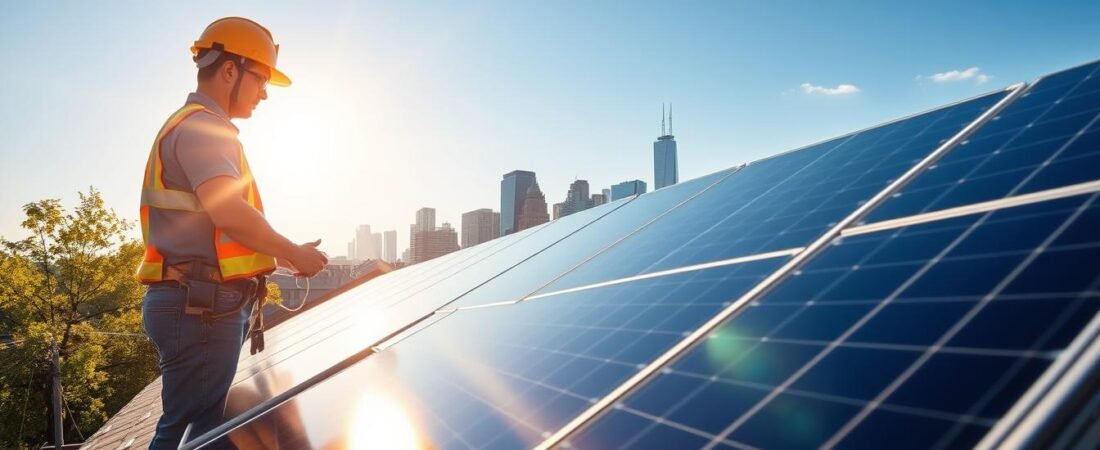
This guide helps Philadelphia homeowners move toward renewable energy with confidence. You’ll get clear facts on technology, costs, and local rules so you can decide if this upgrade fits your home and budget.
We review the current market in Pennsylvania, highlight key utility rules like PECO’s net metering, and explain how incentives affect long-term returns. Simple checks—roof suitability, shading, and local permits—are covered so you know what to expect.
Our roadmap shows how to vet reputable installers, estimate system costs, and maximize savings. Practical steps and clear terms make it easier to compare offers and avoid common pitfalls.
Read on to learn how to evaluate your home as a candidate for a high-performance system and to make a smart, well-informed investment.
Why Solar Energy is Growing in Philadelphia
With electricity costs climbing fast, many homeowners are choosing to generate their own power at home.
Local rates rose sharply: Philadelphia reached 17.79 cents per kWh in 2024, a roughly 31% jump since 2020. Pennsylvania averages moved from 13.8 to 17.8 cents per kWh in recent years.
The price trend makes clean energy more attractive. A household that adds a rooftop system can reduce exposure to future utility hikes. Over the life of a system, self-generated power often grows in value as grid rates climb.
Many residents see another upside: predictable monthly costs. A properly sized system gives steady output and can lower long-term bills for a typical home for 20–25 years.
- Higher rates drive interest among city homeowners.
- Self-generation helps hedge against rising electricity bills.
- Installing panels supports both savings and local emissions cuts.
Understanding the Costs of Solar Panel Installation in Philadelphia PA
Understanding how size, price per watt, and incentives interact makes budgeting for a system easier.
Per‑watt pricing gives a quick way to compare offers. As of April 2026 the average is $2.76 per watt. That metric helps you judge quotes from different companies.
System size changes the total price. A typical 11.17 kW system averages about $30,875 before incentives, with a range from $26,244 to $35,506. A smaller 5 kW setup runs roughly $13,816.
Financing makes higher up‑front costs manageable. Many homeowners use loans or payment plans to spread payments over several years.
- Check company reviews and data to confirm fair pricing.
- Most systems last 25–30 years, so view the cost as a long‑term investment.
- Get a personalized estimate—every home and roof layout is unique.
Financial Benefits and Long Term Savings
Examining payback timelines and lifetime savings makes the economic case for home energy generation easier to see.
Key figures: A typical Philadelphia household can expect about $60,721 in savings over 25 years. The average payback period sits near 9.67 years, after which the system produces net profit.
These numbers assume current electricity rates and projected utility inflation in the region. By generating your own power, homeowners hedge against rising prices and gain long-term budget predictability.
- A typical home reaches significant savings across the 25-year warranty term.
- Payback in under 10 years means most of the system life delivers pure savings.
- Available incentives can cut the initial cost and shorten the payback period.
Bottom line: While upfront price matters, the long-term savings and the protection from future electricity hikes make the investment attractive for many homeowners.
Navigating Local Solar Incentives and Rebates
Financial support from utilities and state grants often makes adopting clean energy far more affordable for homeowners.
Net metering in Pennsylvania requires investor‑owned utilities to credit you 1:1 for each kilowatt‑hour you send to the grid. That credit can cut your monthly electricity bill and shorten your payback time.
PECO offers a meter rebate: customers can receive up to $400 to help cover the cost of the second meter required for interconnection. This is an easy, direct way to lower upfront cost.
State grant programs, such as awards from the Commonwealth Financing Authority, fund larger clean energy projects and distribution upgrades. These programs often benefit community or multi‑system efforts.
- Philadelphia’s city rebate of $0.20 per watt is currently suspended; watch for future updates.
- Stacking these solar incentives and grants with federal options cuts total cost and speeds savings.
- Work with a reputable company to ensure correct paperwork and data are filed for each program.
Tip: Review each program’s rules—some require minimum system size or specific installation dates. Proper planning makes it easier to claim every available dollar.
The Step by Step Installation Process
Most projects finish in one to three days, but the prep work starts weeks earlier with permits and equipment orders.
Site survey: Your chosen company will visit to map the roof, check shading, and confirm racking points. This step sets expected system output and cost estimates.
Permits and paperwork: Permit filing and utility forms happen before crews arrive. Many homeowners let the company handle this. For details, see get a permit to install solar.
On-site work: Crews attach racks, secure modules, and complete wiring and inverter setup. Proper electrical connections ensure safe, efficient electricity flow for years to come.
- Typical time on your roof: one to three days, depending on complexity.
- Final municipal or utility inspection is required before interconnection.
- Professionals will clean the site and verify all equipment is secure.
Tip: Read company reviews in advance. Good feedback shows the team handles installations with care and technical skill.
| Phase | Who Handles It | Typical Time |
|---|---|---|
| Site survey | Installer | 1–3 days lead time |
| Permits & paperwork | Installer / Local office | 1–3 weeks |
| On-site build & wiring | Installation crew | 1–3 days |
| Inspection & activation | Town/utility | Days to 2 weeks |
Comparing Financing Options for Your Home
Choosing how to pay for a home system matters for both short-term budget and long-term value. Different financing paths change who owns equipment, who handles upkeep, and who claims tax benefits.
Leasing and program choices
Leasing often removes upfront cost and transfers maintenance to the provider. For example, Palmetto’s LightReach lease program can start as low as $94 per month with no initial investment. That makes it simple for homeowners to start saving on electricity right away.
Purchasing and ownership
Buying a system requires more capital or a loan, but it gives you long-term savings and tax credits. Ownership usually yields stronger lifetime returns and adds home equity.
- PPAs let you pay only for the power produced at a set price per kWh while the company keeps ownership.
- Leases suit those who want predictability and no maintenance duties.
- Purchase fits buyers aiming for maximum savings and incentives over time.
Before signing any contract, read terms closely. Understand price escalators, transfer rules, and how the program affects your long-term savings and home value.
Selecting a Trusted Solar Installer
A trustworthy contractor ensures your system meets code, performs well, and keeps value over time.
Start by checking verified reviews and a strong history of successful installations. Look for local firms such as Integrated Home Energy, Public Service Solar, LLC, and Green Power Energy that have clear track records.
Ask about post‑installation monitoring. Companies that offer live monitoring help you spot performance drops and protect your clean energy output.
Make sure the company explains financing options and available incentives. A professional team will also handle permits and interconnection paperwork so the project moves smoothly.
Communication matters. Choose a firm that gives clear timelines, written warranties, and maintenance tips. This reduces surprises and keeps your home system productive for years.
| Criteria | What to Ask | Why It Matters |
|---|---|---|
| Reviews & References | Read recent customer feedback | Shows reliability and quality of work |
| Monitoring | Post‑install performance tracking | Detects issues early and preserves output |
| Permits & Paperwork | Experience with local codes | Saves time and avoids delays |
| Financing & Incentives | Available loan or rebate options | Maximizes savings and payback |
For help finding a reputable local partner, see our trusted installer guide.
Monitoring Your System Performance
Simple monitoring tools help homeowners spot drops in production before they become big problems.
With an average of 4.8 peak sun hours per day in Philadelphia, your system should deliver steady daily power for the home.
Most modern solar apps show real-time energy output and historical trends. That visibility makes it easy to see if the panels meet expected yields.
Regular tracking helps you catch shading, wiring, or inverter faults early. Small issues fixed quickly keep performance high for years.
Many programs also include remote monitoring from the provider. That service can confirm production guarantees and speed repairs when needed.
Check daily generation against your electricity use to see how much of your bill is offset. Over time those numbers show true savings and system health.
- Track daily output on the app.
- Compare production to expected values.
- Contact your program provider for alerts or service.
Conclusion
To conclude, compare quotes, incentives, and financing options to find the best fit for your house and goals.
Proven value: Many homeowners see major long‑term savings—roughly $69,000 over 25 years for a typical setup—while protecting against rising electricity costs.
Net metering credits and local incentives make going solar more affordable. Use trusted reviews and ask each company for a personalized estimate for your roof and usage.
Next step: Gather two or three offers, check program rules, and choose the financing path that matches your budget. Small upfront planning yields big savings and cleaner energy for years to come.