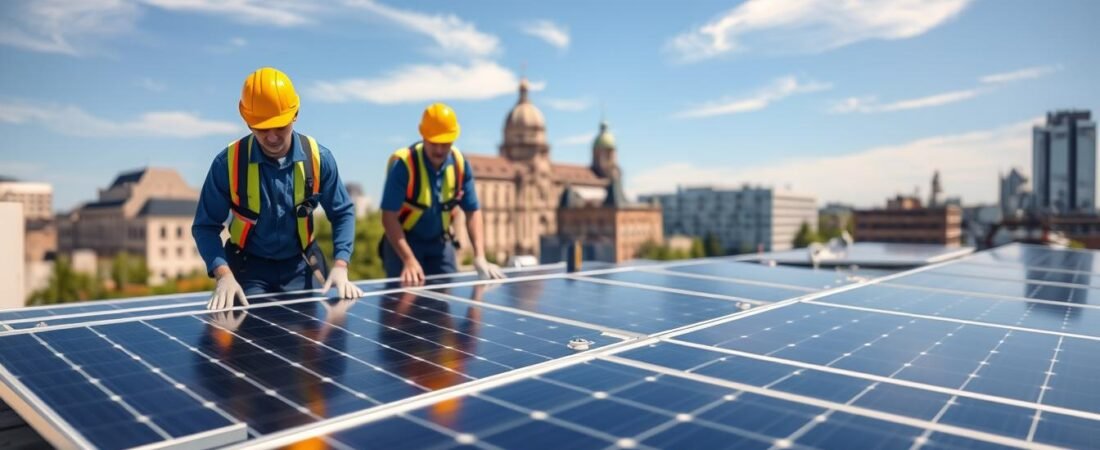
Raleigh homeowners face rising utility bills and many are choosing a local route to energy savings. This guide helps you compare options and find trusted help for a smooth transition.
We connect you with top-rated providers and share practical details about permits, safety codes, and expected warranties. Since 2020, Palmetto has completed over 2,076 installations in North Carolina, showing how demand has grown in the Triangle.
Learn how to evaluate bids, check credentials, and weigh financing choices. Understanding net metering, tax credits, and potential savings makes it easier to decide if this move fits your home and budget.
Ready to start? Use our list of vetted companies and resources to compare quotes and verify coverage. For local options and expert reviews, see a helpful directory of top Raleigh installers.
Why Raleigh Homeowners Are Switching to Solar
As power costs climb, more residents are evaluating systems that can lower bills over time. Local data shows a clear financial nudge for change.
Rising Electricity Rates
North Carolina saw electricity prices rise about 24% from 2020 to 2024. That jump drove many homeowners to look for alternatives.
Solar Potential in Raleigh
Raleigh averages 5.1 peak sun hours daily and more than 213 sunny days each year. This makes on-site power generation productive for most homes.
- Higher rates push owners to reduce monthly energy bills.
- Good sun exposure means systems reach strong production year-round.
- Many customers report positive service and experience with local industry providers.
- Homeowners should review company warranties and battery cost information before committing.
| Metric | Value | Impact |
|---|---|---|
| Electricity change (2020–2024) | +24% | Higher bills; stronger ROI for systems |
| Peak sun hours | 5.1 hrs/day | Consistent generation potential |
| Sunny days/year | 213+ | Reliable annual output |
| Average homeowner savings | Varies by system size | Significant over years with proper sizing |
Tip: Gather quotes, check service history, and compare warranties before going solar to maximize savings and protect your home investment.
Understanding the Solar Panel Installation Raleigh NC Process
A clear timeline helps homeowners know what to expect when a new rooftop energy system goes up.
On-site work usually takes one to three days by a certified crew. The team mounts roof racking, runs wiring, and connects inverters. Local officials then inspect the work to meet safety standards.
Your chosen company typically files permits and manages documentation. This reduces delays and keeps the project on schedule.
- Experienced customers say the short time on site is worth reliable energy for years.
- We give clear information on how to prepare your home before crews arrive.
- Adding a high-quality battery to the system boosts independence and cuts grid reliance.
| Step | Typical Time | Who Handles It |
|---|---|---|
| Permit & paperwork | 1–2 weeks (varies) | Company |
| On-site work | 1–3 days | Certified crew |
| Inspection & activation | 3–7 days | Local officials / utility |
Tip: Ask your installer about expected cost, service warranties, and the experience of past customers to plan the best outcome for your home.
Financial Benefits and Long-Term Savings
Crunching the numbers early gives you a clear view of how quickly a new home system pays back. Use a real-world estimate to compare price, expected savings, and the effect of incentives over the life of the system.
Calculating Your Return on Investment
Raleigh homeowners can expect sizable returns: an estimated $59,000 in savings over 25 years if the system offsets most household electricity use.
Tip: Try our online estimate tool to tailor results to your home’s energy profile. It factors in local incentives and possible battery costs to show a realistic payback period.
“Choosing a reputable company helps ensure your system is optimized for maximum energy production through every season.”
How to evaluate price: Compare upfront cost, warranty terms, and the projected year-by-year production. Include battery integration only if the numbers improve lifetime value.
- Use the estimate to check annual savings and total money kept over years.
- Factor in north carolina incentives to reduce initial cost.
- Talk to customers and request production data from the company before you decide.
Navigating Local Solar Incentives and Rebates
Local incentives can shave thousands off your project, so knowing how rebates and credits stack up matters. This short guide lays out key programs that help lower the upfront cost and improve long-term savings for homeowners in north carolina.
Duke Energy Rebate Programs
Duke Energy offers a one-time rebate of up to $9,000 for a solar-plus-battery system. That makes combining storage with generation an attractive route to lower out-of-pocket cost.
Federal and State Tax Credits
Federal tax credits reduce the net cost of equipment and installation. State-level rebates and incentives may stack with federal credits to cut your payback period by several years.
Virtual Power Plant Participation
Joining a Virtual Power Plant program lets customers share battery data and earn monthly credits. Participating homeowners can receive up to $92 per month in bill credits for helpful grid services.
- Work with an approved company so your system qualifies for rebates.
- Combine batteries with generation to maximize incentives and savings.
- Ask for clear information and production data before signing contracts.
“Pairing storage with incentives can transform cost projections and lower bills sooner.”
Comparing Solar Lease Options Versus Cash Purchases
C. Leases can lower near-term bills, while a cash purchase can lock in ownership and bigger savings later.
Lease option: Programs like Palmetto’s LightReach start near $95/month for a medium-sized home. A lease requires little to no upfront price and can cut your electricity outlay right away.
Cash purchase: Buying a complete system typically costs about $22,970. Paying cash removes monthly payments and gives you full ownership of equipment and long-term savings.
How to compare: Look at total cost over 10–25 years, warranty coverage, and industry standards for service. Include possible incentives and any battery value when you run the numbers.
- Ask Duke Energy about flexible financing for north carolina customers.
- Request production and warranty details from each company before signing.
- Use a side-by-side cost model to see which choice improves savings and energy independence over the years.
Environmental Impact of Clean Energy in the Triangle
Homeowners who add generation and storage make a measurable difference for the region’s climate.
A 10 kW system can offset about 10 tons of carbon dioxide each year. That is roughly the same benefit as planting 175 trees.
Choosing clean energy reduces reliance on traditional electricity and improves local air quality. Adding a battery helps you use more on-site power and boosts overall impact.
“Our data shows long-term carbon savings that stack up over years when homeowners adopt distributed generation.”
- 10 tons CO2 saved per year from a 10 kW system.
- Equivalent of 175 trees planted in reduced emissions.
- Battery integration increases usable clean power and storage value.
| Item | Annual Impact | 25-Year Estimate |
|---|---|---|
| 10 kW system | ~10 tons CO2 | ~250 tons CO2 |
| Tree equivalent | 175 trees (annual) | Equivalent to thousands of trees over 25 years |
| Battery + system | Higher self-use of clean energy | Greater lifetime CO2 reduction |
How to Evaluate Top-Rated Local Solar Installers
Choosing the right local installer starts with a simple checklist that highlights experience, guarantees, and customer feedback.
Key Criteria for Vetting Companies
Key Criteria for Vetting Companies
Look for a company with a proven track record in north carolina and clear data on past projects.
- Ratings and reviews: High scores from real customers show consistent service quality.
- Warranties: Aim for 25-year warranties on the system and equipment for long-term protection.
- Transparent cost: A reputable firm gives a detailed estimate and explains incentives.
- Experience: Check years in the industry and average time to complete a panel installation.
Reading Customer Reviews
Customer feedback offers practical information about installation time and overall experience.
“NC Solar Now earned a 5.0-star rating from EcoWatch for professional service and quality equipment.”
Read multiple reviews to spot patterns in communication, follow-up service, and final cost. Pay attention to comments about battery integration and post-activation support.
Tip: Use our data-driven approach to compare companies by service records and verified reviews before you sign.
Essential Equipment for Your Home Solar System
Good equipment keeps your home energy system productive and reliable for decades.
Core components include high-efficiency panels, a dependable inverter, and sturdy racking. These parts work together to convert sunlight into usable electricity and protect performance for 20–25 years.
Storage matters. Adding a battery lets your home store surplus energy for cloudy days and evening use. That increases self-reliance and can improve long-term savings.
Professional panel installation ensures wiring, grounding, and inverter settings meet safety codes and run at peak efficiency. Proper setup also preserves warranties and reduces future service needs.
- Choose Tier-1 equipment to maximize longevity and manufacturer support.
- Inspect racking and seals to prevent roof damage and water intrusion.
- Schedule routine maintenance to keep production steady and spot issues early.
Tip: For a detailed checklist and trusted service options, review our guide to system selection and local services: guide to solar panels and professional equipment services.
Managing Your Energy Bills with Net Metering
When your system creates more power than you use, the Net Metering Bridge Rider converts that surplus into value. This credit helps lower monthly bills and improves the overall return from going solar.
Understanding the Net Metering Bridge Rider
Under the rider in north carolina, excess electricity is credited at $0.034 per kWh. That rate applies when customers send extra energy back to the grid.
How it helps: Credits offset your electricity charges each billing cycle. Tracking production and battery use lets you maximize the credit and monthly savings.
- Credits apply to excess generation exported to the grid.
- Use a battery to store midday output and reduce exported kWh when rates are low.
- Compare expected annual credits to your system cost and incentives.
- Confirm with your utility or company on policy details for your home.
| Item | Rate / Value | Impact on Bills |
|---|---|---|
| Export credit | $0.034 / kWh | Direct reduction on monthly bill |
| Battery use | Varies by system | Can boost self-consumption and lower exports |
| Average homeowner effect | Depends on production | May shorten payback years and increase savings |
“Track production and battery usage each month to make net metering work harder for your household.”
Next steps: Ask your utility for the NMB details and request production data from your installer. That information helps estimate yearly savings and plan the best use of clean energy at your home.
Increasing Your Property Value Through Solar
A clean-energy upgrade can make your property stand out in listings and speed up the sale process.
Research shows homes with solar panels in north carolina sell for about 4.1% more than similar houses without an on-site system. That bump adds real dollar value at closing.
For many homeowners, a professional panel installation is both a cost-saving measure and a marketable feature. Buyers often value lower monthly electricity bills and the promise of long-term energy savings.
- Higher sale price: Roughly 4.1% premium in local sales data.
- Better curb appeal: Clean, well-mounted panels look like a quality upgrade.
- Stronger offers: Energy features attract eco-minded buyers and investors.
“Investing in reliable equipment and a trusted company pays off when you list your home.”
Tip: Keep clear documentation of warranties, production estimates, and permits. That information reassures buyers and supports the added value your upgrade brings to the home.
Conclusion
Choosing clean upgrades in north carolina helps homeowners save on monthly bills and support local clean energy goals.
By using available incentives and rebates, you can cut the cost of professional installation and boost long-term value. Review equipment choices and company records so your system performs well for many years.
We encourage customers to use the information here, compare offers, and pick reliable teams for their solar panels. For more on our approach and team, learn about our team and start planning your energy upgrade today.