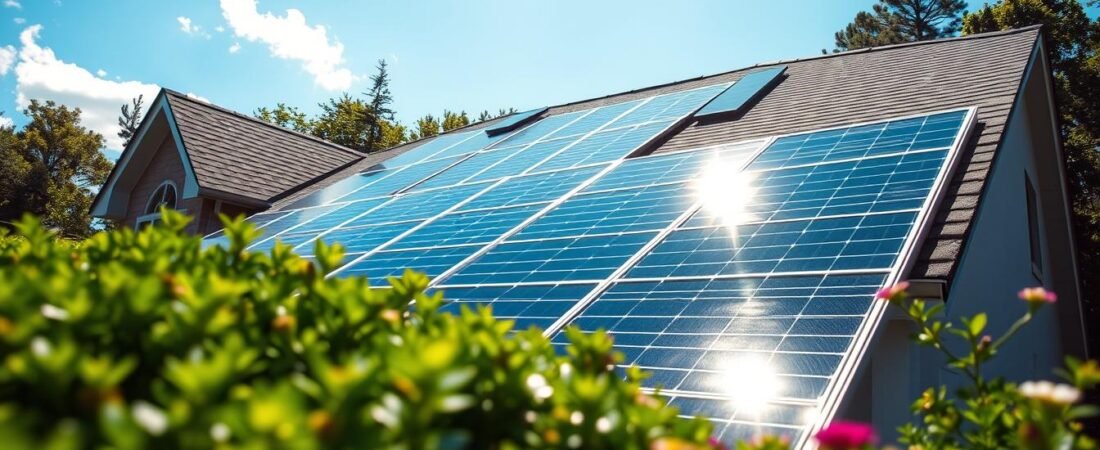
Ready to make a smart energy choice? This guide breaks down the local price landscape and what it means for homeowners in the area.
As of April 2026, the average system price sits at $2.36 per watt including installation. A typical setup in the region is about 14.01 kW and is sized to capture the 5.2 peak sun hours common to South Carolina.
Choosing professional installation helps ensure your equipment performs well and maximizes long-term savings. Local incentives can also cut your out-of-pocket price and boost returns.
What to expect: many homeowners here lock in predictable energy bills and may save roughly $27,443 on electricity over 25 years. Our guide will walk you through quotes, system sizing, and the timeline from site visit to activation.
Understanding the Current Solar Market in Greenville
Local utility rate shifts have pushed more homeowners to consider rooftop generation as a hedge against rising bills.
The region saw average electricity rates climb from 12.9¢/kWh in 2021 to 14.1¢/kWh in 2024. Duke Energy’s 2023 rate of 12.7¢/kWh remains below the state average. These moves in rates shape the payback for any new system.
Many homeowners now explore home solar options to offset higher monthly bills. Demand for professional panel installation and local installers has risen. Installers here know the permitting and interconnection steps, which shortens timelines.
- Rising rates increase the appeal of generating your own energy.
- More residents choose reputable installers to maximize long-term savings.
- Higher efficiency panels mean better output on cloudy days.
| Metric | 2021 | 2024 |
|---|---|---|
| State average rates (¢/kWh) | 12.9 | 14.1 |
| Duke Energy rate (¢/kWh) | 12.7 | 12.7 |
| Market trend | Moderate interest | Growing adoption |
Factors Influencing Your Solar Panel Cost Greenville
Two things—roof condition and household energy use—explain most price differences between quotes.
Roof characteristics such as angle, orientation, and shading dictate daily output. A south-facing roof with good tilt will deliver more power during the 5.2 peak sun hours common to the area.
Roof Characteristics
Roof age and structural strength matter. Older roofs may need repairs before installation, which raises the overall investment.
Energy Usage Patterns
We size systems to match yearly electricity needs. A well-matched system size limits overspending and improves long-term savings.
- Higher-efficiency panels reduce the number of modules required.
- Cost-per-watt helps compare quotes across different system sizes.
- Local installers can assess your roof and expected output for your area.
| Factor | Effect on Price | Action |
|---|---|---|
| Roof orientation | High impact | Prefer south-facing or minimal shading |
| Roof condition | Moderate impact | Repair or reinforce before install |
| Energy profile | High impact | Right-size the system to actual use |
| Panel efficiency | Variable | Choose higher-efficiency models to lower array size |
Pro tip: factor in available incentives when weighing price and performance to maximize your return on investment.
Average Pricing and System Size Considerations
Start with your average monthly electricity use to determine how much generation your home needs. That figure makes it simple to pick a system size that matches daily habits and seasonal shifts.
Typical local price points: a 5 kW system runs about $11,802, while a 10 kW option costs roughly $23,603. The regional average system is 14.01 kW and averages $33,069.
Note: costs scale almost linearly with capacity, so doubling capacity roughly doubles the price. That makes it easy to estimate different sizes from known benchmarks.
- Match monthly kilowatt-hour use to a size that offsets most of your bill.
- Smaller systems lower upfront price but extend payback; larger systems raise savings faster.
- Compare panels cost and labor across installers to ensure fair pricing for equipment and installation.
| System Size (kW) | Approx. Price | Best for | Estimated Payback Impact |
|---|---|---|---|
| 5 | $11,802 | Small homes, partial offset | Longer payback |
| 10 | $23,603 | Average household offset | Moderate payback |
| 14.01 (avg) | $33,069 | Larger homes or high usage | Shorter payback |
Understanding the main factors that influence price and size helps you pick a budget-friendly system that meets energy goals. Professional installation teams can verify the right match by reviewing past bills and any efficiency upgrades.
Financial Benefits of Going Solar
Making the move pays off for many homeowners. South Carolina offers a 100% property tax exemption for residential systems up to 20 kW. That protects your assessed value after installation.
Adding panels often raises resale value. A Zillow study finds a roughly 4.1% lift in home value for properties with a rooftop system.
Property Tax Exemptions
The exemption is automatic. Your local assessor will not tack on extra property tax just because you added a panel array.
- State exemption: 100% property tax protection for systems up to 20 kW.
- Combined benefits: Use the state tax credit and the exemption to lower total installation cost and shorten payback.
- Long-term savings: Homeowners typically start seeing a positive return within the first decade.
| Benefit | Impact | Notes |
|---|---|---|
| Property tax exemption | Protects home value | Up to 20 kW, automatic |
| Home value increase | ~4.1% uplift | Based on resale data |
| Electricity savings | Lower monthly bills | Improves ROI over time |
Navigating South Carolina State Incentives
State-level incentives and utility rules can change the math on a new home energy system. Understanding these items helps you estimate real savings and choose the right setup.
State Tax Credits
South Carolina offers a 25% state tax credit for qualifying systems. That credit is capped at $3,500 per year and can be claimed for up to ten years.
This credit lowers your tax liability and spreads benefits over time, making larger systems more affordable for many homeowners.
Net Metering Policies
Duke Energy ended 1:1 net metering in 2021. Now, excess electricity is credited at a reduced rate of about 2.6–4¢ per kWh.
Because credits are smaller, adding a battery or sizing your system to match daytime use can improve financial returns.
Community Solar Programs
Community options let residents participate in a shared system when their roof or shading makes on-site installation impractical.
These programs give access to clean power and similar tax incentives without a rooftop array.
| Incentive | Benefit | Notes |
|---|---|---|
| State tax credit | 25% of system price | Up to $3,500/year for 10 years |
| Net metering | Reduced export credit | Duke Energy credits excess at 2.6–4¢/kWh |
| Community programs | No roof required | Good for shaded or rent-occupied homes |
Bottom line: use the state tax credit and weigh net metering rates when planning installation. These incentives can significantly improve long-term savings and the payback timeline for your panel system.
Exploring Financing and Leasing Options
Financing options let homeowners access clean energy without a large upfront payment.
Leases and PPAs let you start with no down payment. Palmetto’s LightReach lease can begin with monthly payments as low as $92/month. A PPA means you pay only for the electricity the system produces at an agreed rate.
Buying vs. leasing affects long-term savings and ownership. Buying often increases lifetime savings but needs a larger investment. Leasing lowers immediate outlay and shifts maintenance to the owner of the panels.
- Loans let you finance system size while keeping incentives for owners.
- Leases often include production guarantees and service.
- PPAs are best if you prefer paying for produced power only.
| Option | Upfront | Monthly | Best if |
|---|---|---|---|
| Purchase | High | Low (after loan) | Max savings, take incentives |
| Lease (LightReach) | None | From $92 | Low entry, no maintenance |
| PPA | None | Per kWh | Pay for produced electricity |
Tip: Compare offers by total payments, guarantees, and how each affects your monthly bills and long-term savings.
Comparing Quotes from Local Installers
Compare several offers to get the best mix of price and service. A quick review of bids reveals how installers in your area handle sizing, warranties, and paperwork.
Get at least three bids today so you can compare labor, equipment, and permitting fees side by side. Competitive bidding often uncovers better warranties and clearer timelines.
How to evaluate each quote
- Ask for a detailed breakdown of cost solar components, including labor, equipment, and permits.
- Check which local installers help apply for local incentives and rebates to lower your net price.
- Compare guarantees on production, workmanship, and equipment to protect long-term savings.
- Use a marketplace like EnergySage to gather custom quotes; data shows competition can reduce prices by up to 20%.
Bottom line: review reputation and service as carefully as the price to pick a system that fits your home and electricity goals for the area.
Evaluating Long Term Energy Savings
A long-term savings forecast shows how much predictable value you can lock in by producing your own power.
Homeowners in the area typically see an estimated $27,443 in electricity savings over a 25-year period. That figure helps you compare the installation price to expected returns.
Key factors that shape savings include net metering rates, future utility increases, roof orientation, and panel efficiency. Each affects how much energy the system produces each year.
Use a simple ROI check: subtract projected savings over the period from your initial investment to see payback time. Smaller systems lower upfront costs but may lengthen payback. Larger systems raise production and often shorten the period to positive returns.
Practical tip: choose higher-quality panels and match system size to your home’s usage. That boosts long-term savings and makes it easier to use saved money to pay off the system faster.
Conclusion
Good financial outcomes come from matching system size to real household use and local rules.
For many homeowners, installing a solar system and quality panels is a sound investment that cuts energy bills and boosts resale value.
Take full advantage of the 25% state tax credit and the property tax exemption to lower upfront price and shorten payback.
Compare multiple quotes, confirm warranties, and weigh buying versus leasing so you get the best overall price and performance.
Understand net metering and local solar incentives to maximize returns. With the right choices, your new energy system will pay dividends for years.