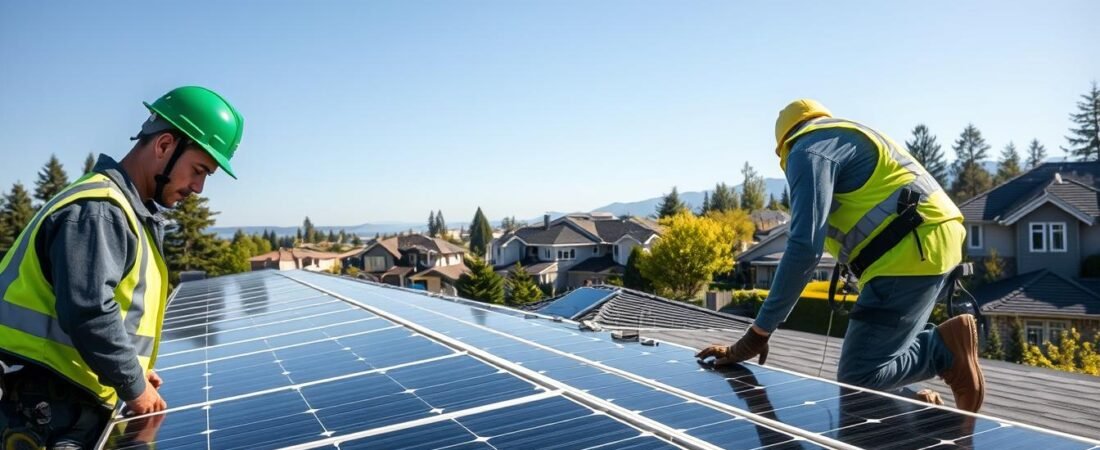
Finding a reliable provider is the first step for homeowners who want to harness clean energy across the Evergreen State.
Our concise guide highlights top-rated firms and key industry standards to help you choose with confidence. We focus on real benefits, cost savings, and proper system setup to protect your investment.
Washington residents gain the most when they pair professional guidance with local incentives and proven installers. This article is meant to be your go-to resource for understanding the regional landscape and making smart choices for your home.
Key takeaways:
- How to identify trusted companies and important standards.
- Ways to maximize long-term energy savings and system safety.
- Local tips for homeowners in Washington considering a switch to renewables.
Why Washington is a Prime Location for Solar Energy
The Evergreen State combines improving technology and solid savings, turning common myths about cloudy skies on their head.
Overcoming Weather Misconceptions
Washington averages just over 150 sunny days each year, but modern equipment captures usable power on overcast days too.
High-efficiency panels and smart inverters extract energy across varied light conditions. Reputable solar companies report reliable year-round output in the Pacific Northwest.
Long Term Energy Savings
Most systems in the state deliver more than $14,200 in lifetime savings for homeowners. That figure includes lower utility bills and reduced peak charges.
Going solar often pays back the initial cost while increasing home value and cutting monthly expenses.
- Year-round generation reduces bills in all seasons.
- Top installers provide warranties and service to protect performance.
- Compare quotes and reviews to find the best solar company for your needs.
| Metric | Typical Cloudy-Year Result | Typical Sunny-Year Result |
|---|---|---|
| Average annual output | 85% of peak | 100% of peak |
| Estimated lifetime savings | $12,000+ | $14,200+ |
| Payback period | 7–11 years | 6–9 years |
To learn more about local expertise and our experience, visit about our team when comparing companies and equipment.
Understanding the Solar Panel Installation WA Landscape
Finding the right company in Washington starts with research. There are over 60 installers serving the state, so homeowners must compare options carefully.
A&R Solar stands out for regional expertise, while Blue Raven Solar is noted for flexible financing. Look beyond brand names to verify service history and customer reviews.
Focus on these key checks:
- Transparent quotes and clear cost breakdowns.
- Warranty terms and the record of past installations.
- Local experience that matches Washington’s climate and energy needs.
Shortlisting helps you find best providers that match roof type, system size, and budget. Ask each company for equipment specs and recent customer feedback.
For a deeper look at local electrical considerations see how electrical systems work in the Puget Sound. Explore regional service options at local service options to compare warranties and quotes.
Key Factors to Consider When Selecting a Solar Company
A careful vetting process helps you secure a dependable system and lasting support.
Start by confirming a candidate can back your system for 25 years. Ask for written warranty terms and service commitments.
Look for licensed, insured teams that use certified electricians. That protects your home and meets local code.
Transparency matters: the best solar companies deliver clear quotes that break down total cost, projected energy output, and timeline.
Choose companies washington residents trust for solid reviews and varied equipment options. Reputable providers show product specs and offer multiple panels to match household goals.
| Factor | What to Verify | Why it Matters |
|---|---|---|
| Warranty & Support | 25‑year coverage; written terms | Protects production and repairs long term |
| Licensing & Insurance | Local license; liability and workers’ comp | Reduces liability and ensures safe work |
| Quotes & Reviews | Detailed cost and energy estimates; customer feedback | Helps you compare cost, service, and experience |
- Confirm installer credentials and recent project references.
- Compare equipment options and total lifecycle cost.
Evaluating Professional Experience and Industry Certifications
Evaluating a company’s track record and credentials reduces risk and helps you pick a dependable provider.
Years of experience matter. We suggest choosing companies with at least five years experience. Longevity often signals steady service, steady crews, and documented projects customers can verify.
Verifying Licenses and Insurance
All electrical work in Washington must be done by a licensed electrical contractor and certified electricians. Confirm the company presents contractor numbers and proof of insurance before signing any agreement.
Installations require permits and inspections administered by the Washington Department of Labor and Industries. An experienced installer will manage permits and pass inspections efficiently.
- Look for NABCEP or similar certifications to show quality training.
- Ask for copies of liability and workers’ comp insurance.
- Request references, recent photos of equipment, and written warranty terms.
Tip: Compare quotes, reviews, and product lists from multiple companies to spot the best solar company and ensure the proposed system, cost, and warranty match your goals.
Navigating Solar Financing and Payment Options
How you pay for a system can change your true ROI more than equipment choice.
Start by comparing cash and financed quotes from the same company. Loans often add dealer fees that raise the total by 20% or more. Ask for both a cash price and a financed price so you can see the difference.
Solar Loans and Dealer Fees
Loan offers vary by rate, term, and dealer fees. Many companies bundle fees into monthly payments, which hides true cost.
Tip: Compare APR, fees, and total paid over the loan term before signing.
Understanding Escalator Clauses
Leases and PPAs may include escalator clauses. Ideally, escalators stay below local electricity growth—about 3% annually.
Higher escalators can erode savings. Read contract language and ask current customers about real payment increases.
| Option | Main Cost Drivers | When it Fits |
|---|---|---|
| Cash | Upfront equipment and labor | Best for max long-term savings |
| Loan | Interest + dealer fees | Good if you want ownership and rebates |
| Lease/PPA | Monthly payments + escalator | Lower upfront cost; check clause rates |
The Importance of Robust Warranty Coverage
Warranty detail often separates dependable companies from those that cut corners. A strong warranty protects your home, your cost outlay, and the long-term performance of the system.
Prioritize installers that offer both equipment guarantees and a workmanship or labor warranty. We recommend at least a ten-year labor warranty to cover any damage from installation.
Some manufacturers, like SunPower, add a system performance guarantee that promises specific output over time. That gives customers confidence in both products and service.
- What to check: whether the warranty covers parts, labor, roof repairs, and performance shortfalls.
- Confirm transferability in case you sell the house.
- Read exclusions so you know when repairs may be billed to you.
| Warranty Type | Typical Length | What it Covers |
|---|---|---|
| Product | 10–25 years | Manufacturing defects, equipment failure |
| Performance | 10–25 years | Minimum energy output guarantees |
| Workmanship / Labor | 10+ years (recommended) | Installation damage, roof penetrations, repairs |
Final tip: ask each solar company for written warranty terms before you accept quotes. Compare reviews and experience to ensure the company will honor repairs and service long term.
Comparing Solar Quotes for Your Home
Side-by-side estimates reveal real differences in expected output, warranties, and total cost.
Get at least three quotes from reputable companies to see how equipment, labor, and service compare. Ask each provider to list the system size and the projected energy production for your house.
Use the typical Washington average price range of $2.22–$3.32 per watt as a benchmark. Be cautious of bids far below or above this range; they may omit fees or use lower-quality products.
- Confirm each quote lists roof shading, panel efficiency, and expected annual energy.
- Compare warranty terms, labor coverage, and service obligations.
- Favor installers with several years experience in the local market and solid reviews.
| Metric | What to Expect | Why It Matters |
|---|---|---|
| Per watt | $2.22–$3.32 | Helps spot underpriced or overpriced bids |
| Estimated output | Home-specific kWh/yr | Shows real energy value |
| Warranty & service | Equipment + labor terms | Protects long-term performance |
Tip: Review equipment lists and customer reviews for every company before you decide.
Maximizing Savings Through Local Incentives and Rebates
Local rebates and federal credits can cut thousands off your upfront cost when you plan carefully.
The 30% federal tax credit applies to eligible equipment, including battery storage. That credit alone can reduce a big portion of the purchase price.
Washington homeowners typically pay about 10% more than the national average. That makes local incentives and state rebates important to lower the overall cost.
Federal and State Tax Credits
Key actions:
- Claim the 30% federal credit when you buy qualifying equipment.
- Work with experienced companies that know state-specific rebates and application steps.
- Use net metering to earn credits for excess energy you export to the grid.
“Taking full advantage of credits and rebates can shave thousands from the average system cost and improve payback.”
The average price for a complete system in Washington is roughly $33,600 before incentives. Applying the federal credit and local programs can cut that substantially.
| Incentive | Typical Benefit | Who Should Check |
|---|---|---|
| Federal Tax Credit (30%) | Reduces federal tax liability; thousands off cost | All homeowners buying qualifying equipment |
| State/Local Rebates | Varies; lowers upfront price or adds point-of-sale savings | Residents using local programs or utility incentives |
| Net Metering | Credits for excess generation; improves ROI | Homes with potential to export energy to the grid |
Pro tip: choose a company and installer with experience navigating incentive paperwork. They help ensure you receive every available saving and meet program deadlines.
The Role of High Efficiency Equipment in Cloudy Climates
In cloudy regions, choosing higher-efficiency equipment makes a big difference to year-round output.
Washington sees just over 150 sunny days per year, so homeowners need components that perform well in low light. Top-tier manufacturers such as Maxeon, Tesla, Panasonic, REC, Enphase, and Silfab build products tuned for such climates.
High-efficiency panels often cost more up front, but they can deliver greater energy over the life of a system. That improves payback and reduces net cost per watt.
Choose a trusted solar company that explains efficiency ratings and matches equipment to your roof and local weather. A reputable company will balance durable products, solid warranty terms, and installer experience to protect long-term performance.
| Feature | Why it Matters | What to Ask |
|---|---|---|
| Low-light efficiency | More generation on overcast days | Supply lab specs and real-world data |
| Manufacturer support | Long warranties and replacements | Confirm warranty length and coverage |
| Life-cycle cost | Higher initial cost can mean better ROI | Compare cost per watt and expected kWh/yr |
Professional Installation Versus DIY Approaches
Choosing a trained crew over a DIY kit can protect your roof and wallet in Washington’s wet climate.
Professional crews bring methods to seal roof penetrations correctly. This lowers the chance of leaks in areas that can get 150–200 inches of rain a year.
Risks of Roof Leaks
Poorly sealed openings cause water intrusion and structural damage. Even small mistakes during a DIY project can lead to costly roof repairs.
Experienced installers use flashing, approved sealants, and roof-specific fasteners to prevent leaks. That workmanship protects your home and the system beneath it.
Warranty Limitations on DIY Kits
Most DIY kits include limited equipment coverage, typically five to ten years. They often lack labor or performance guarantees.
Professional companies usually offer longer product and labor warranties that transfer with a sale. That means peace of mind and fewer out-of-pocket repairs over time.
| Aspect | DIY Kits | Professional Service |
|---|---|---|
| Risk of roof leaks | High if inexperienced | Low with proper sealing |
| Warranty coverage | 5–10 years equipment only | 10–25 years product + labor |
| Energy performance | Standard kit outputs | Optimized for local climate |
| Long-term cost | Lower upfront, higher repair risk | Higher upfront, lower lifetime cost |
Bottom line: hire a qualified installer with verified years experience and a written warranty that clearly states what the warranty covers. That saves money and protects your investment in the long run.
How Solar Energy Impacts Your Property Value
Investing in a quality energy system often converts into higher sale prices and stronger offers.
Studies show that installing solar on a Washington home raises property value by about 4.1%. With an average state home price near $566,052, that equals roughly $23,208 in added value.
This upgrade is viewed favorably by many buyers. A documented home solar system can be a clear selling point.
Keep in mind property taxes may rise when assessed value increases. Still, long-term energy savings and added equity often outweigh that cost.
Work with experienced companies to get paperwork that proves your system’s output and warranty coverage. Good documentation helps buyers trust the product and the installer.
- Higher resale price: Average 4.1% boost in Washington.
- Documentation: Performance records and warranty increase buyer confidence.
- Equipment quality: Top products keep homes attractive to future purchasers.
| Metric | Typical Impact | What to Ask Your Company |
|---|---|---|
| Home value uplift | ~4.1% (~$23,208 on avg WA home) | Recent appraisal or comparable sales with systems |
| Buyer appeal | Higher offers; faster sale | Provide performance reports and warranty transfer terms |
| Tax and costs | Possible higher property taxes | Estimate tax change and net long-term savings |
Assessing Customer Service and Reputation
A track record of fast, clear communication is one of the best signals of reliable post-sale support.
When choosing solar, prioritize companies with a reputation for strong customer service. Good support matters over a 25-year life span.
Read reviews on Google and Yelp to see how a company responds to questions and problems. Look for timely replies, polite staff, and follow-through.
Ask about years experience working in your area. Installers with local experience usually solve permit, roof, and equipment issues faster.
“A trustworthy company will explain products, be clear about the warranty, and never pressure you to sign immediately.”
Check how companies washington treat employees and customers. Respectful teams often deliver better workmanship and ongoing service.
- Confirm a clear service process for callbacks and repairs.
- Verify warranty handling and how claims are processed.
- Speak to recent customers when possible for real feedback.
What to Expect During the Installation Timeline
Once you sign a contract with a chosen solar company, work begins quickly. First, the team schedules a site visit to inspect your roof and electrical panel and to confirm shading and roof condition.
Your installer then manages permits, orders equipment, and files required paperwork. This step removes hassle for the homeowner. Expect permit approval times to vary by city.
The on‑roof work usually takes one to three days. Crews mount racking, secure panels, and connect inverters and wiring. Weather and roof complexity can extend time modestly.
After physical work, a local building inspector checks safety and code compliance. Once the inspector signs off, your installer coordinates final utility interconnection.
Tip: ask your company for a simple timeline and a copy of the permit packet. Clear communication from installers reduces surprises and speeds the start of your home solar energy.
| Step | Typical Duration | Who Handles It |
|---|---|---|
| Site visit & quote | 1–7 days | Installer / sales rep |
| Permits & equipment order | 1–4 weeks | Installer |
| On‑site work | 1–3 days | Installation crew |
| Inspection & utility hookup | 1–2 weeks | Inspector & utility with installer coordination |
Conclusion
Deciding on the right company wraps up the process and starts years of dependable home energy savings. A clear plan and honest expectations protect your budget and roof.
Choose one of the best solar companies that shows strong experience, quick response to the customer, and solid service terms. Pick installers who document work and stand behind products and workmanship.
Leverage federal and local incentives and check equipment lists to reduce upfront costs. Prioritize robust warranties and efficient products to maximize energy output over the next years.
With careful research and a trusted installer, your home can enjoy reliable clean energy and increased value for many years.