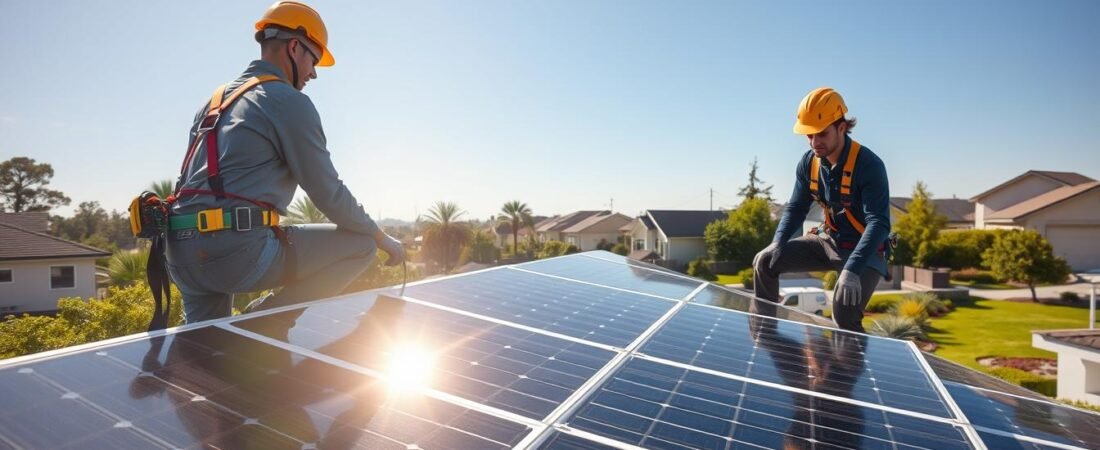
Thinking about adding a home renewable system? The average residential system price is about $21,816, according to analyst Catherine Lane.
Experts use National Renewable Energy Laboratory data to give clear estimates for homeowners across the United States. This helps you weigh the upfront price against long-term electricity savings.
Our guide makes the numbers easier to follow. We walk through equipment, labor, rebates and tax incentives so you see the full picture.
Understanding size, roof layout, local utility rates and expected savings helps you decide if the investment fits your goals. Read on for a simple breakdown of the factors that shape final pricing.
Understanding the Solar Panel Cost to Install
What determines the final price for a residential renewable system? Hardware quality, labor, local utility rates and roof layout drive most of the expense.
Modern units use advanced cells and smarter inverters to maximize power and support everyday living. Prices have dropped sharply—about 45% over the last decade—making these systems much more reachable for many homeowners.
Remember that modules are one element of a full installation package. Equipment, permits, wiring and optional battery storage add to the total. Routine maintenance stays low, but occasional cleaning or repairs should be budgeted.
Compare quotes carefully: check panel efficiency, labor warranties and available incentives or rebates in your state. Many homeowners find long-term electricity savings and added home value outweigh the upfront investment.
Average Pricing for Residential Solar Systems
Benchmarks help set realistic budgets. For example, a 7.2 kW system averages $21,816 before incentives, which equals about $3.03 per watt.
System size drives final pricing. Larger arrays, such as 10 kW setups, usually lower the per-watt figure compared with smaller 4 kW installs. A typical 6 kW array runs near $19,140 before rebates and tax incentives.
System Size Impact
Choosing the right size depends on annual electricity use and roof space. Homeowners should review utility bills and work with a pro to match consumption.
Cost Per Watt
Using per-watt figures makes comparisons fair across proposals. Data from the National Renewable Energy Laboratory offers useful benchmarks for different sizes and equipment levels.
- 7.2 kW ≈ $21,816 total, $3.03 per watt
- Larger systems often yield lower per-watt pricing
- Verify energy data before final sizing to avoid excess capacity
Key Factors Influencing Your Total Investment
Household electricity use is the single biggest driver of what your final investment will look like. Higher consumption means more panels and a larger system size. That raises the upfront cost but can boost long-term savings.
Choosing premium efficiency panels can add about 25% to equipment price, yet they often deliver more power over the years. Adding a battery will further increase your total by roughly $15,000, depending on capacity and brand.
Roof orientation, slope and shading change how many modules fit and how complex the installation becomes. Local labor rates and your chosen installer also shape final figures.
- Energy needs dictate the number of panels required on your roof.
- Larger systems spread soft costs across more watts, lowering per-watt figures.
- Climate and state utility rates affect electricity production and payback.
Always weigh upfront cost against long-term value. Incentives, tax credits and lower maintenance can make a bigger system a better investment for many homeowners.
Regional Variations in Solar Pricing
Prices vary widely from state to state because local labor markets, permit rules, and sunlight all shape final bids.
Understanding regional differences helps homeowners compare quotes fairly. Labor and permitting fees often explain most of the variance. Sunshine exposure changes how many panels a household needs for the same energy output.
State-by-State Price Differences
Key drivers include:
- Local labor rates and permit fees that raise or lower overall installation costs.
- Interconnection rules from utilities that change project timelines and expenses.
- Sun hours per year—more sun often means fewer panels and lower system size needs.
For example, data show Florida averages about $2.61 per watt, which sits below many states. Analysts use Bureau of Labor Statistics and EIA data when tracking these gaps.
Tip: Check state incentives and local rebates. They can offset higher labor or equipment prices and improve long-term savings.
Breakdown of Equipment and Soft Costs
Breaking down what you actually pay for reveals why final bids differ so much.
Equipment and soft fees split the bill in surprising ways. Hardware like inverters, racking and wiring is vital, but it does not dominate the price.
Hardware Components
Modules account for roughly 12% of the total. Inverters typically represent about 10%–11% and are crucial for converting DC into usable AC power.
Racking, wiring and battery add-ons also contribute. Together, this hardware forms the tangible part of the system and affects long-term efficiency and maintenance.
Labor and Permitting
Labor often runs between 5.5% and 7% of the project budget, per National Renewable Energy Laboratory benchmarks.
Permitting, inspection and interconnection fees vary by municipality. Those soft costs can lengthen timelines and raise the final price.
Customer Acquisition
Customer acquisition and overhead are large soft-cost drivers. Many companies report that marketing and sales make up about 15% of the total.
Why this matters: soft costs often exceed hardware spend. Understanding each line helps homeowners compare quotes and spot fair market pricing.
- Tip: Ask providers for an itemized quote that separates equipment, labor, permits and acquisition fees.
- Use NREL benchmarks when you evaluate pricing and expected total cost.
Comparing Different Financing Methods
Your financing route can add thousands in interest or fees, changing the true price of ownership. A simple choice now affects monthly bills and long-term savings.
Cash purchases are usually the cheapest option. Paying upfront avoids interest and dealer fees and gives homeowners full access to incentives and tax credits.
Loans are popular, but read the fine print. Many loans add dealer fees that average 19.99% of the principal. Over a 20-year loan, interest and fees can swell the total you pay.
“Ask for the total loan payoff figure, including any origination or dealer fees, before you sign.”
- Cash: Lowest total expense and fastest path to savings.
- Loan: Spreads payments but may include high fees and interest.
- Lease/PPA: No upfront cost, but you don’t own the system and miss most long-term savings.
When comparing options, request an itemized loan payoff, estimate years until breakeven, and confirm which incentives apply for owners. That helps you pick the financing that best fits your home and budget.
Hidden Expenses to Consider
Before signing a contract, homeowners should map out likely extra expenses that lie outside the headline quote. A clear checklist helps protect your budget and keeps the project on track.
Roof Condition and Repairs
Replacing or repairing a worn roof can add thousands to the project. Schedule an inspection early so you know if shingle or structural work is needed.
If panels must be removed later for roof work, removal and reinstallation often runs about $3,800 when not covered by a lease. That fee can surprise many owners.
Electrical Upgrades
Older homes may need a 200-amp service or extra wiring to handle a new energy system safely. Electrical upgrades are a safety requirement and affect the final total.
Also note: monitoring service fees or modest increases in homeowners insurance can add recurring expenses. Some installers add extra charges for complex roof shapes or hard access.
- Tip: Get a roof report and an electrical assessment before signing.
- Budget for removal/reinstall fees and small recurring charges.
Evaluating the Long-Term Value of Solar
A clear payback estimate shows when your home starts reaping years of essentially free electricity.
Average payback runs near 10 years in the United States. After that, many homeowners enjoy about 15 years of very low or no electricity bills. That shift can sharply change lifetime costs and monthly budgeting.
A properly sized system can nearly eliminate your utility bill. This raises resale value, and many states offer property tax exemptions so your taxes do not rise with added value.
Return on investment depends on local rates, sun exposure, and panel efficiency. Compare current electricity bills with projected annual savings, and factor in incentives and federal tax credits for a full picture.
| Metric | Typical Value | Why It Matters |
|---|---|---|
| Average payback | ~10 years | Timeline until savings exceed upfront expenditures |
| Free energy period | ~15 years | Years with minimal electricity bills after payback |
| Home value impact | Positive; often increases | Can boost resale price; many states protect via tax exemption |
Bottom line: Treat an array as a long-term investment. If your roof, size choice, and local rates align, the system can deliver strong savings and add durable value while supporting renewable energy goals.
Professional Installation Versus DIY Risks
Choosing a professional crew can protect your roof, your warranty, and your peace of mind. Many homeowners try a DIY approach to save on labor, but that choice carries clear hazards.
Safety is the top concern. Handling high-voltage wiring and rooftop work exposes people to falls, shocks, and structural damage. Licensed installers train for those exact risks.
Safety and Warranty Concerns
DIY work can void manufacturer warranties and create gaps in insurance coverage. If equipment fails or the roof leaks later, homeowners may face the full repair burden.
Over 1.5 million Americans have connected with trusted companies to ensure systems are safely integrated and permitted. Many local jurisdictions require licensed installers for code compliance and inspection sign-off.
- Proper sizing: Professionals match system size to home needs and local rules.
- Permits and labor: Licensed crews handle permits, wiring, and roof flashing correctly.
- Protection: Reputable firms offer insurance and workmanship guarantees for your investment.
“Peace of mind from a pro often outweighs any short-term savings from a DIY approach.”
Bottom line: For most homeowners, paying for a trained team reduces risks, preserves warranties, and protects long-term savings.
Navigating Solar Incentives and Rebates
Federal and local incentives can trim thousands from your total project and shorten payback timelines.
The federal tax credit has allowed homeowners to claim 30% of total system costs, though rules change for 2026. That credit often makes a large dent in the upfront cost and improves long-term savings.
Many states and utilities layer on rebates, performance-based payments, or renewable energy certificates. Net energy metering is especially valuable; it credits excess electricity so you recover value when the system underproduces.
Check local programs carefully. Use the Database of State Incentives for Renewables and Efficiency (DSIRE) and consult your installer to identify every applicable rebate and tax break.
- Tip: Combine federal credits, state rebates, and net metering credits to lower the effective system price.
- Ask installers for help with paperwork and qualification requirements to avoid missed savings.
- Consider renewable energy certificates if your state offers ongoing income for generation.
“Maximizing incentives turns a higher upfront expense into a much stronger long-term investment.”
For a practical checklist and regional guidance, see our Massachusetts incentives guide.
Conclusion
, Deciding between quotes, size options, and available rebates helps you move forward with confidence.
Investing in a solar panel installation can deliver meaningful savings and a smaller carbon footprint. Review projected costs, claim incentives, and confirm which size fits your household.
For safety and warranty protection, prefer professional panel installation over DIY. Get at least three quotes from reputable firms and compare itemized bids for system components and installation fees.
With careful research and clear comparisons, installing solar becomes a sound long-term choice for many homeowners. Use this guide as a checklist when you request final bids.