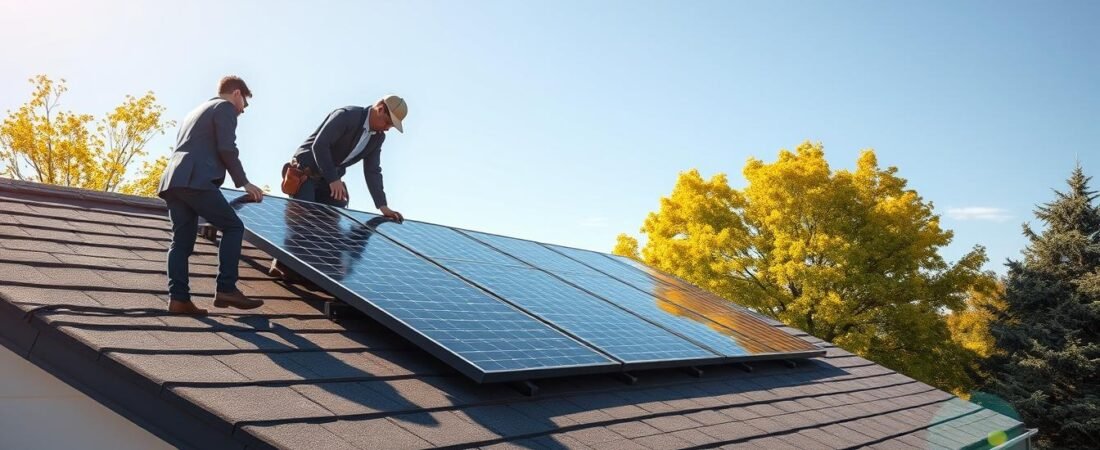
Thinking about a home energy upgrade? A typical 12 kW system averages $30,505 before incentives, and many homeowners see savings between $37,000 and $154,000 over 25 years. Prices today are among the lowest recorded, with NREL noting that rates were about 22% higher a decade ago.
Understanding how system size and equipment affect your price helps you plan. Take advantage of the federal tax credit and local incentives to lower the net outlay. Doing so makes going solar a smarter financial move for long-term electricity bills.
The main benefit is predictable energy costs and protection from rising utility rates. With competitive markets and better options, most homeowners can find a setup that fits their roof, budget, and goals.
Key takeaways: Know the average cost for a 12 kW system, expect substantial long-term savings, and use tax credits and incentives to cut your net price.
Understanding Solar Panel Cost Installation
Breaking down what you pay for reveals where most project dollars actually go.
Equipment—the modules, racking, and wiring—usually makes up less than one-third of a home system’s price. Labor, permitting, and other soft fees commonly represent a larger share.
Business operations such as sales, marketing, and overhead also add to the final price. That is why two quotes for similar systems can differ by thousands of dollars.
When you evaluate offers, look for transparent line items. Check permitting and interconnection fees and confirm how warranty and maintenance are handled.
- Compare equipment and service levels to ensure you get long-term value.
- Ask about interconnection—DOE initiatives like SolarApp+ aim to speed this step and lower fees.
- Verify installer reputation to protect your energy production and savings over 25 years.
| Cost Category | Typical Share | Impact on Price |
|---|---|---|
| Equipment (modules, racking, wiring) | ~30% | Medium — affects long-term output and reliability |
| Labor & Soft Costs | ~40–50% | High — varies by home and permits |
| Business Overhead & Sales | ~15–25% | High — reflects company support and warranties |
| Permitting & Interconnection | ~5–10% | Variable — can add several thousand dollars |
Average Pricing for Residential Systems
Average pricing for a home system is easiest to compare when you use a per-watt metric. EnergySage reports a national average of about $2.58 per watt before state or local incentives. That number helps buyers turn varied quotes into apples-to-apples comparisons.
Cost per Watt Metrics
Price per watt shows the base value of any offer. It blends equipment, labor, and soft fees into one figure you can use to compare installers.
Comparing quotes by per-watt price makes differences in service and warranty clearer. Always ask for the full breakdown behind the number.
Impact of System Capacity
Larger systems usually lower the per-watt price thanks to economies of scale. The National Renewable Energy Laboratory benchmarks confirm that system size often drives unit pricing.
Choosing a system that more closely matches your household electricity needs can improve long-term savings. Use per-watt comparisons to spot the best value across quotes.
| Metric | What it shows | Why it matters |
|---|---|---|
| Price per watt | Base comparison figure | Easy to compare offers |
| System capacity | Total kW of panels | Impacts per-watt price and output |
| Incentives | Net price effect | Can lower upfront average cost |
Breaking Down Equipment and Soft Costs
A clear bill of materials makes it easy to see where most project dollars go.
Panels often account for less than one-third of total equipment value. The rest covers inverters, racking, and wiring that keep a system reliable.
High-quality inverters, such as microinverters or module-level power electronics, can boost production on roofs with shading or many planes. That choice raises the upfront price but can improve long-term savings and energy output.
Soft costs are a big part of the final quote. Permitting, inspections, interconnection, and installer overhead add time and fees that vary by location and company.
- Equipment: panels, inverters, racking, wiring.
- Soft costs: permits, inspections, sales, and administration.
- Value: opt for durable gear when it increases lifetime output.
| Category | Typical Share | Effect on Price |
|---|---|---|
| Modules & mounting | ~25–35% | Medium — affects durability and warranties |
| Inverters & electronics | ~15–25% | High — influences production, especially on complex roofs |
| Soft costs (permits, overhead) | ~35–50% | High — varies by local rates and installer efficiency |
How System Size Influences Your Budget
Picking the right system size is the single biggest decision that shapes your project budget.
Your chosen system capacity affects the average cost per watt because many soft fees spread across total kilowatts. Larger systems usually mean lower per-unit rates, much like buying in bulk.
Economies of Scale
Buying more capacity often reduces the unit price. Labor, permitting, and overhead do not rise as fast as the number of modules, so the effective system cost per kW falls with size.
For many homes a 12 kW setup is common, but your ideal size depends on annual electricity use and roof constraints. Bigger systems can deliver greater long-term savings by offsetting more monthly bills.
“A larger system often cuts the average price per watt and improves payback time.”
| Factor | Effect | Why it matters |
|---|---|---|
| System capacity | Lower price per unit for larger systems | Spreads fixed soft fees across more output |
| Electricity usage | Determines needed size | Matches generation to household demand |
| Roof & equipment needs | May raise total project complexity | Can increase labor and upgrades despite larger scale savings |
Practical tip:calculate yearly electricity use before choosing size. That helps balance upfront system cost and long-term savings while avoiding unnecessary extra capacity.
Impact of Roof Characteristics on Pricing
A simple, sunny roof reduces labor and design time, trimming what homeowners pay.
Orientation and slope matter. A south-facing roof at about a 30-degree angle gives the best balance of output and price. That alignment often needs fewer panels to meet household energy needs, which lowers overall project totals.
Complex roofs raise labor and design fees. Multiple planes, dormers, or skylights require more layout work and mounting hardware. That adds both time and expense to the project.
Shade also affects the final budget. Removing or trimming trees can cost between $300 and $1,500. Factoring this into your plan helps protect projected savings and system performance.
Roof condition is another factor. Replacing an aging roof before work avoids redoing the system later and prevents added upkeep and warranty issues.
- Good orientation and slope reduce the number of panels and the per-unit price.
- Complex roofs increase labor, design, and equipment needs.
- Address roofing repairs and shade removal ahead of time to protect long-term savings.
| Roof Feature | Effect on Price | Typical Range |
|---|---|---|
| South-facing, 30° slope | Lowest labor/design needs | Most cost-effective |
| Multiple planes/dormers | Higher labor and design fees | Moderate to high |
| Shaded roof (trees) | May require removal/trimming | $300–$1,500 |
| Aging roof | Recommend repair/replacement first | Avoids future rework |
“Proper assessment of your roof ensures safe, optimized system output and avoids unexpected expenses.”
Geographical Variations in Solar Rates
Where you live changes how many panels you need and what you pay for a home system.
Sun Exposure Differences
Sun hours vary widely across the U.S. More sun means fewer panels to hit the same electricity goal. That lowers the total price and speeds payback.
States like Arizona often show lower average figures because high irradiation cuts required system size. In contrast, Nebraska and South Dakota can see higher per-watt pricing.
Local Labor and Permitting
Local fees matter. Labor rates, permit charges, and inspection timelines all add to final installation costs. Municipal rules can add time and expense.
- Get local quotes—prices and incentives differ by state and county.
- Check state incentives and tax credits that lower net prices.
- Ask installers about typical permitting timelines for your roof and site.
| Region | Effect on Price | Why it matters |
|---|---|---|
| High sun (e.g., AZ) | Lower system size | Fewer panels needed; faster savings |
| Low sun (e.g., NE, SD) | Higher per-watt | Need more panels; higher upfront price |
| Local markets | Variable labor/permits | Can add or trim thousands to final bill |
Evaluating Your Potential Energy Savings
A clear payback estimate turns abstract savings into an actionable timeline for homeowners.
Most households reach a break-even point in about 10 years. After that, the electricity generated by your panels is essentially free for the remainder of their life, boosting long-term savings over 25 years.
To calculate your break-even point, divide the total system price minus any incentives by your expected annual reduction in utility bills. That gives a simple payback year figure you can compare across offers.
- Estimate total price after incentives (include tax credits).
- Calculate expected yearly savings on electricity bills.
- Divide net price by annual savings to find payback years.
Tip: Faster increases in local electricity rates shorten payback and raise lifetime savings. A well-sized system that matches your household usage delivers the best financial outcome.
Want a guided checklist? See this planning resource for more details on sizing and incentives: planning a home system.
Comparing Cash Purchases and Solar Loans
Your payment choice—cash or loan—directly affects how much you pay over the system’s life. Decide whether avoiding interest outweighs tapping savings for immediate energy savings.
Cash purchases usually deliver the lowest overall price. You pay once, skip interest, and avoid dealer fees that lenders may add. That path often yields the fastest return in terms of years of payback.
Loans let homeowners start saving on electricity right away without a large upfront payment. But some loans include dealer fees that raise the principal and increase total costs over time.
Understanding Dealer Fees
Always ask for a clear fee breakdown. Dealer fees can appear as an origination charge or as added finance costs. These add to the system price and can change the value of financing.
| Option | Primary benefit | Watch for |
|---|---|---|
| Cash | Lowest total price; faster payback | Immediate upfront expense |
| Loan | No big down payment; instant savings | Dealer fees, interest |
Tip: You can still claim the federal tax credit if you own the system with a loan. Ask your installer for a side-by-side comparison of cash versus financed scenarios to see which delivers better long-term savings.
Benefits of Subscription and Leasing Models
Leasing and subscription plans let many homeowners get clean power on day one without a big upfront payment. Plans like the Sunrun Subscription often start at $0 down and bundle routine maintenance and repairs into the monthly fee.
With a lease you do not own the system, but you still see immediate reductions in electricity bills. Predictable monthly payments make budgeting easier for a home energy upgrade that otherwise might be out of reach.
Key advantages:
- Start saving on energy bills immediately with no large upfront price.
- Providers handle repairs and upkeep, removing technical responsibility.
- Monthly fees are predictable for many years, simplifying cash flow.
- Contribute to cleaner power on your roof without owning the equipment.
| Feature | Lease/Subscription | Cash/Own |
|---|---|---|
| Upfront payment | $0–low | High one-time |
| Maintenance | Included | Owner responsibility |
| Long-term savings | Lower short-term; variable long-term | Higher over years |
Tip: Compare projected savings, available incentives such as a tax credit, and contract terms before choosing a lease or buying a system outright.
Long Term Maintenance and Repair Considerations
A few routine tasks and timely replacements will keep energy production steady for decades.
Owning your system means planning for simple upkeep and the occasional major service. Most systems are low-maintenance, but small actions protect long-term output and savings.
Routine Cleaning Requirements
Dust, leaves, and bird droppings can lower output. Light cleaning once or twice a year typically preserves efficiency.
Professional cleaning runs about $15–$30 per panel, depending on roof height and access. Many homeowners find that fee small compared with yearly electricity savings.
Inverter Replacement Cycles
The inverter is a key service item. Expect replacement roughly every 10 to 13 years for most systems.
Factor this into long-term planning and budgets. Replacing the inverter restores performance and can extend overall system life.
Warranty Coverage
Manufacturer and installer warranties protect against defects and premature failures. Read terms closely for labor, parts, and performance guarantees.
Tip: Ask your installer for a clear maintenance schedule and warranty summary. For repair guidance, see this resource on repairs and servicing.
- Regular inspections preserve output and spot wear early.
- Planned inverter replacement avoids sudden drops in production.
- Warranty clarity reduces unexpected repair bills.
“The National Renewable Energy Laboratory notes that durable systems still need routine care to deliver long-term performance.”
Navigating Modern Solar Incentives
Federal and local incentives can cut your upfront bill and speed payback for many homeowners.
The federal tax credit remains a major tool for lowering the net price of a solar panel installation. It directly reduces the amount you owe on your tax return, so factor it into early quotes.
State and municipal rebates or performance-based incentives can stack with the federal benefit. These programs vary by address and by system size, so local research matters.
Net metering often delivers extra value by crediting excess electricity your panels send to the grid. For many homeowners, that increases lifetime savings and shortens payback.
- Ask your installer which incentives you qualify for.
- Check program deadlines and application rules early.
- Include expected incentives when you compare net system cost.
| Incentive Type | What it does | Typical benefit |
|---|---|---|
| Federal tax credit | Reduces tax liability | Large one-time savings |
| State/local rebates | Lowers upfront price | Varies by location |
| Net metering | Credits excess electricity | Boosts long-term savings |
“Take time to map incentives to your address and system size before committing to a quote.”
Conclusion
A clear action plan helps turn estimates into steady monthly savings and higher home value.
Evaluate quotes for equipment, warranties, and local incentives before you commit to a solar panel installation. Match system capacity to your usage to avoid overbuying and to improve payback.
Compare projected savings against the solar panels cost and the net benefits from local rebates. Focus on long-term reliability, not just the average cost or the upfront cost alone.
With thoughtful choices — from financing to gear — you’ll get decades of cleaner energy and lower bills. Take the next step with one or two trusted installers and a clear checklist.