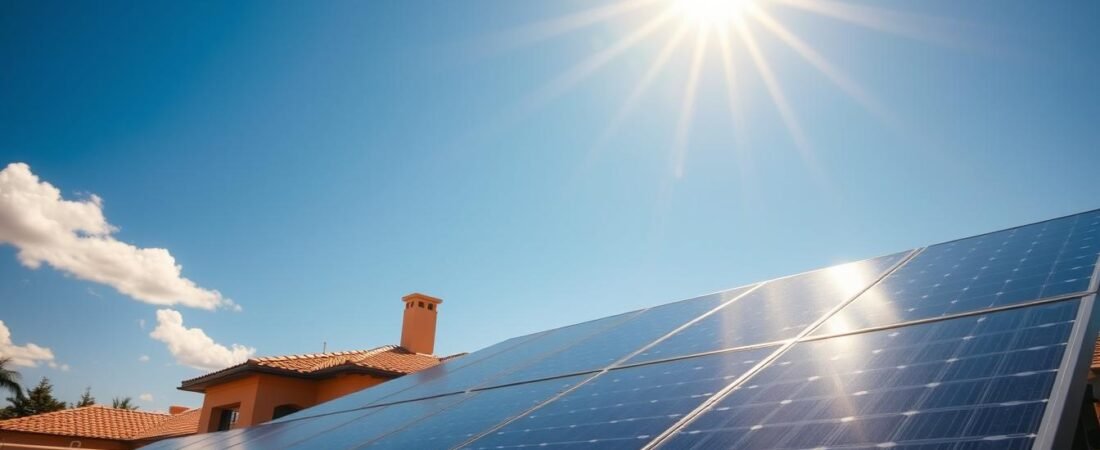
Thinking about adding solar to your home? This short guide helps homeowners in Wilmington weigh the benefits, system size options, and likely savings. North Carolina saw electricity prices rise 24% from 2020 to 2024, so many people are looking for steady ways to manage rising energy bills.
Wilmington gets over 213 sunny days per year, making it one of the sunniest East Coast cities. That weather helps systems produce reliable power and faster returns on investment.
Local experience matters. Palmetto completed 2,076 installations across North Carolina since 2020, showing proven expertise for residential installation projects.
This guide walks through installation basics, likely system sizes, incentives like tax credit and local rebates, and how to estimate true costs versus long‑term savings. Read on to decide if adding renewable energy fits your home and budget.
Why Wilmington is a Prime Location for Solar Energy
Coastal Wilmington enjoys bright, reliable sunlight that makes rooftop systems more productive than in many nearby cities. This steady exposure helps homeowners see stronger energy production and faster payback from their investment.
Coastal Climate Benefits
Salt air and humidity can be tough, but modern equipment is built to last. Manufacturers use durable coatings and corrosion‑resistant frames so panels keep producing for many years.
That resilience matters for long-term savings. Durable systems reduce maintenance needs and help preserve warranty coverage and resale value.
Peak Sun Hour Advantages
The region averages about 5.1 peak sun hours daily. That level of sunlight lets a modest system offset a large share of a home’s electricity use.
In practice, this means homeowners can choose a slightly smaller array to hit energy goals. That reduces upfront costs while keeping projected savings strong over the years.
“High peak sun hours make installations more efficient and shorten the time to recover the initial investment.”
- Over 213 sunny days annually supports consistent production.
- 5.1 peak sun hours boosts daily generation.
- Durable designs handle coastal conditions for long service life.
| Factor | Local Value | Benefit to Homeowners |
|---|---|---|
| Sunny days per year | 213+ | More reliable annual energy production |
| Peak sun hours | 5.1 hrs/day | Higher daily generation per system size |
| Coastal conditions | Salt air, humidity | Requires corrosion‑resistant equipment |
| Homeowner impact | Reduced grid reliance | Stronger long‑term savings and investment value |
Understanding the Solar Panel Cost Wilmington Homeowners Face
Knowing typical local rates makes it easier to budget for a home renewable system. The average price per watt in this area sits around $2.80 per watt, which helps when you request quotes.
A typical cash purchase for an average home is near $22,970. That figure changes with equipment quality, installation complexity, and your household’s energy needs.
- Larger system size increases the total but can lower the per‑watt price.
- Higher‑efficiency panels raise upfront price but may boost long‑term savings.
- Local incentives and the federal tax credit reduce net investment for many homeowners.
| Metric | Typical Value | Why it matters |
|---|---|---|
| Average price | $2.80 per watt | Useful for quick estimate solar bids |
| Typical cash buy | $22,970 | Budget baseline for residential solar system |
| Drivers | Equipment, size, home usage | Determine final panels cost and payback years |
Bottom line: Understanding how much solar panels could cost helps you plan an investment that balances upfront price with long‑term savings and energy independence.
How Electricity Rates Influence Your Solar Investment
Rising utility rates are reshaping the financial case for home renewables across North Carolina. Higher retail rates make on-site generation more valuable because each kilowatt you produce avoids buying power from the grid.
Rising Utility Rates in North Carolina
Between 2020 and 2024, electricity rates climbed about 24%, from 11.3¢ to 14.1¢ per kWh. That jump increases the projected payback for a typical system and raises annual savings for homeowners.
Duke Energy Progress, which serves most local customers, has shown steady rate rises. That trend makes producing your own power a practical hedge against future increases.
“Homeowners can save an estimated $59,000 over 25 years by going solar, providing a buffer against rising energy costs per year.”
- Track your electricity usage to size a system that offsets the right share of demand.
- Generating some or all of your home’s electricity stabilizes bills for many years.
- Higher utility rates shorten payback and increase lifetime savings from panels and equipment.
Bottom line: When rates keep rising, investing in generation at your home protects you from future spikes and improves long-term savings.
Breaking Down the Components of Solar Installation Costs
Knowing how costs split across equipment, labor, and fees helps you budget smarter. A clear breakdown shows which items are fixed and which vary with system size or roof complexity.
Equipment and Hardware
Modules make up only a slice: the modules account for about 12% of total project pricing. Inverters, racking, and wiring are essential and add meaningful value to the final solar panel system price.
Labor and Permitting
Installation labor typically represents roughly 5.5% of the budget. Complexity, roof pitch, and electrical upgrades raise this share.
Permitting and inspection fees are part of the soft costs but directly affect timelines and final invoices.
Soft Costs and Overhead
Soft costs — permits, overhead, marketing, and overhead — can reach about 19.5% of the total. These fees often differ by installer and location.
“When comparing quotes, ask installers to show an itemized breakdown so you can compare apples to apples.”
- Modules: ~12% of total.
- Inverters, racking, wiring: required hardware included in equipment line items.
- Labor: ~5.5%, varies with roof and electrical needs.
- Soft costs: ~19.5% for permitting and overhead.
- Understanding the split helps homeowners spot better value and potential savings.
| Component | Approximate Share | Impact on Homeowner |
|---|---|---|
| Modules | 12% | Directly affects generation and warranty length |
| Inverters & racking | 15–20% | Critical for performance and system reliability |
| Labor | 5.5% | Higher for complex roofs or electrical upgrades |
| Soft costs (permits, overhead) | 19.5% | Can vary by installer; affects final price transparency |
Comparing Cash Purchases Versus Solar Leasing Options
Deciding between a lump-sum purchase and a monthly lease comes down to cash flow, long-term savings, and risk tolerance.
Cash purchases usually deliver the best savings over the coming years because you own the system and capture incentives, tax credit benefits, and all reduced electricity bills.
Leasing removes the upfront barrier. Palmetto’s LightReach lease program lets homeowners start with no down payment and payments around $95 per month. That can make access to panels and clean energy far easier for many families.
Leases often include maintenance and a production guarantee, which reduces worry about repairs and underperformance. A 90% production guarantee gives peace of mind that the system will generate near expected power.
“Leasing trades long-term value for predictable monthly payments and hands-off upkeep.”
- Buy: higher initial outlay, greater lifetime savings, eligible for tax incentives.
- Lease: low entry, fixed monthly payment, maintenance included.
- Compare projected savings, contract length, and performance guarantees before choosing.
Navigating Federal and State Solar Tax Credit Opportunities
Federal and state tax rules can cut thousands from a home energy upgrade when you claim the right credits.
The federal solar tax credit remains a key incentive. Recent law updates changed eligibility rules for residential projects. Claiming the investment tax credit lowers your upfront expense and improves payback.
State-Level Renewable Energy Credits
North Carolina offers the Renewable Energy Income Tax Credit (RETC) for commercial projects. That program can provide a 35% credit on qualifying property.
Homeowners can register a system with NC-RETS. Registered systems may generate Renewable Energy Certificates (RECs). You can sell RECs, though their market value is often modest.
“Understanding the federal solar tax and state incentives is key to maximizing the return on your residential investment.”
- Federal credit: reduces taxable liability for qualifying installs.
- RETC: 35% credit for commercial property only.
- NC-RETS: register to create and sell RECs.
| Incentive | Who qualifies | Primary benefit |
|---|---|---|
| Federal solar tax credit | Residential & commercial (rules apply) | Direct reduction in federal tax liability |
| Investment tax credit | Property owners who meet program criteria | Lower overall project investment |
| NC Renewable Energy Income Tax Credit | Commercial-only projects | 35% credit on qualifying property |
| NC-RETS / RECs | Registered system owners | Small additional revenue from REC sales |
Plan carefully. Work with a tax pro and your installer to confirm eligibility. This step helps homeowners capture all available savings during installation and in the years that follow.
Evaluating the Duke Energy PowerPair and Battery Programs
Duke Energy’s PowerPair rebate can make a big difference for owners who add storage to their rooftop setup. The program offers a one‑time rebate up to $9,000 for qualifying solar‑plus‑battery installations.
Customers who join the EnergyWise Home program may earn up to $92 per month in bill credits by allowing limited battery access during peak events. That steady credit can improve annual savings and help offset ongoing electricity bills.
For most residents served by Duke Energy Progress, net metering under the Net Metering Bridge (NMB) rider still shapes total savings. Metering rules affect how much value you get for exported energy.
“Installing a battery system lets you store excess generation and boost the per watt value of your array.”
- The PowerPair rebate lowers upfront investment for combined systems.
- EnergyWise Home adds monthly credits and grid support incentives.
- Net metering policy changes will influence long‑term savings and payback years.
| Program | Benefit | Impact for Homeowners |
|---|---|---|
| PowerPair rebate | Up to $9,000 one‑time | Reduces initial installation and battery costs |
| EnergyWise Home | Up to $92 per month | Provides steady bill credits and grid support |
| Net Metering (NMB) | Export valuation rules | Affects long‑term savings and system sizing decisions |
Impact of System Size on Your Total Investment
Choosing the right system size is the single biggest factor that shapes your upfront investment and long-term savings.
Your required size should match household electricity use, not the roof square footage. That ensures the array offsets as much grid power as you need without overspending.
A 10 kW solar panel system is a common choice for many local homes. It can cover a large share of typical monthly usage and cut utility bills for years.
- Size by usage, not roof area, for the best match to demand.
- Larger systems tend to have a lower cost per watt because fixed soft costs spread out.
- Getting the right size optimizes your investment and long‑term savings.
| System Capacity | Typical Benefit | Homeowner Impact |
|---|---|---|
| 5 kW | Meets modest usage | Lower upfront investment |
| 10 kW | Substantial household coverage | Strong annual savings |
| 15+ kW | High offset and backup potential | Lower per‑watt cost, higher total investment |
“Right‑sizing your system is the most important step in calculating how much solar you need.”
How Roof Characteristics Affect Installation Pricing
How your roof faces the sun and how steep it is will shape both performance and price. Small changes in orientation or pitch can mean you need a larger system size to hit your energy goals.
Roof Orientation and Pitch
South-facing roofs give the best yield, so they often need fewer panels to meet the same output. East- or west-facing roofs may require more equipment and raise the per watt figure.
Steeper pitches can increase labor time and safety measures during installation, which raises final costs. A simple slope usually cuts down on labor and makes the install faster.
Shading and Obstructions
Trees, chimneys, and nearby buildings can cut production. That loss often forces homeowners to add microinverters or extra modules to keep annual energy up.
Complex roofs with dormers, vents, or skylights add time and materials. These features increase labor and can push your panels cost higher than a plain roof.
“A professional roof assessment pinpoints shade issues and helps estimate how much the system could cost to meet your needs.”
- South-facing is most efficient; other orientations may need a larger system size.
- Complex roofs add labor and raise installation costs.
- Shading may require microinverters or more panels to maintain production.
Assessing the Long Term Financial Benefits of Solar
Looking beyond the initial invoice shows how much value a rooftop energy system can deliver over decades. A typical local home can save an estimated $59,000 over 25 years by investing in a high‑quality solar energy system.
The average payback period is about 10 years.
After that break-even point, owners often enjoy roughly 15 years of near‑free electricity generation. That makes the installation a long-term investment in predictable household bills.
- Reduces exposure to rising utility rates by locking in energy prices.
- Generates on-site power and lowers monthly electricity bills.
- Improves financial independence for the home and increases lifetime savings.
“A 25-year view shows savings and stability that short-term analyses miss.”
Before you commit, compare system size, incentives and any available tax credit. For a quick read on resale value and added home worth, see our piece on do solar panels add value.
Does Solar Power Increase Your Home Value
Homes equipped with on-site generation frequently attract higher offers at resale. Zillow research shows properties with solar panels sell for about 4.1% more than comparable houses without them.
For a $350,000 property in this area, that premium equals roughly $14,000. That added value improves the return on your installation investment and helps justify initial costs over the long run.
“Homes with solar panels sell for about 4.1% more than comparable homes without them.”
Important note: The value bump mostly applies to owned systems. Leases or third-party ownership usually do not add the same resale premium.
- Higher resale price complements ongoing energy savings.
- North Carolina exempts qualifying equipment from property tax, so your taxes should not rise because of a system.
- Owned systems strengthen buyer appeal, especially for homeowners who plan to sell within a few years.
| Metric | Impact | Why it matters |
|---|---|---|
| Sale price premium | ~4.1% | Boosts home value and overall investment return |
| Example on $350,000 | ~$14,000 added value | Concrete resale benefit for local homeowners |
| Property tax | Exempt in NC | Preserves tax neutrality after installation |
Selecting the Right Solar Installer for Your Project
Choosing who will design and install your home system is one of the most important decisions you’ll make.
Look for proven local experience. Palmetto has completed 2,076 installs across North Carolina since 2020, which shows vetted expertise for residential work.
Get at least three written quotes. Comparing multiple bids helps you spot hidden fees and ensures you evaluate the same system size, equipment, and labor assumptions.
- Confirm comprehensive workmanship warranties and production guarantees to protect your investment.
- Choose an installer who accounts for shade, coastal weather, and gradual panel degradation in their design.
- Ask about timeline, permit handling, and net metering or tax credit paperwork.
“Choosing the right partner for your installation is the most important step in ensuring your project is completed on time and on budget.”
For a closer look at an experienced local team and their credentials, visit our solar installer page before you sign a contract.
Hidden Costs to Consider Before Going Solar
Before you sign a contract, tally the likely surprises that can add to your total project bill.
Roof repairs and upgrades may be needed to support a new system. Replacing shingles, reinforcing rafters, or fixing leaks can raise the final cost and delay installation.
Inverter replacement is another long‑term expense. Many inverters last 10–15 years, so plan for a swap even if manufacturer warranties cover part of the hardware.
Routine maintenance—cleaning, inspections, and minor repairs—keeps performance high. These small tasks protect savings and extend useful years for the system.
- Account for possible utility upgrades or permit fees that affect the installation timeline and price.
- Factor in system size adjustments if your usage changes; bigger arrays shift per‑watt value and total investment.
- Ask installers for a clear, itemized estimate so hidden fees do not surprise you later.
“Being aware of these hidden costs helps you plan your budget effectively, ensuring your system provides the best possible value.”
Conclusion
Choosing to add a home energy system can lock in predictable monthly bills for years. Rising utility rates make on-site generation a practical hedge, and many homeowners see strong long‑term savings after payback.
Use available incentives. The federal solar tax credit and the investment tax credit can cut upfront expense and improve returns. Local rebates and programs also help lower the net price of installation.
Compare a cash purchase versus leasing to match your cash flow and goals. Right‑sizing the system and accounting for roof conditions keeps panels cost optimized for your home.
Start with three quotes, confirm incentives, and choose an installer who explains warranties and expected savings. That approach gives you the clearest path to value and reliable electricity for decades.