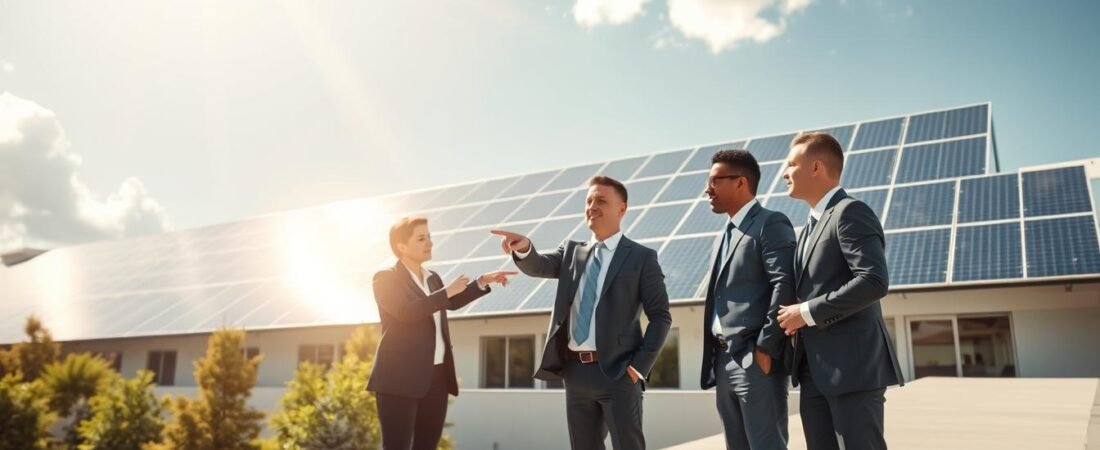
Save money and show commitment to the planet. Investing in efficient systems can cut operating costs and boost your brand reputation in the United States market.
Our expert team focuses on high-quality projects that bring clean energy to your rooftop or lot. We work with trusted names like SunPower to ensure reliable performance and long-term value.
Choose professional installation and you get modern technology built to meet today’s demands. From planning to final inspection, we support your business every step of the way.
Expect reduced expenses and steady power. With the right panels and a skilled installation crew, your organization gains stable returns and a greener footprint for years.
Why Businesses Are Switching to Solar Power
An increasing number of firms now lock in electricity pricing by adding renewable systems to their properties. This move helps protect budgets from volatile utility rates and makes monthly planning easier for any building owner.
Energy Cost Stability
Predictable costs: Switching to commercial solar lets businesses stabilize their energy usage and reduce exposure to rising utility costs. With over 16 years of experience, our team evaluates your needs and designs a system that fits your property and budget.
Marketing Advantage
Stand out to customers: Implementing these systems signals environmental leadership. That reputation attracts modern, eco-conscious customers and strengthens your brand.
“Locking in lower electricity costs delivers both short-term savings and long-term value for your organization.”
| Benefit | Impact | Why it matters |
|---|---|---|
| Cost Stability | Predictable budgeting | Shields business from utility volatility |
| Property Value | Higher resale appeal | Systems increase asset attractiveness |
| Brand Advantage | Better customer perception | Demonstrates sustainability leadership |
Exploring Our Commercial Solar Panel Installations
We design durable energy systems that match your site’s load and business hours. Each solution is tailored to your property and operational goals so you get reliable power and clear ROI.
Proven scale: Our portfolio includes diverse projects, highlighted by TENCO SOLAR’s more than 40 million kW installed across multiple sectors. That track record shows we can handle complex work on any property.
Battery options let you maximize uptime. We offer 208V systems from 20–200 kWh and 480V systems from 42–360 kWh to meet load requirements and provide backup when utility power fluctuates.
- High-quality systems designed to reduce reliance on the grid.
- Quality components chosen for long life and steady performance.
- Precision execution to deliver a durable, low-maintenance solution.
“A well-sized system and storage pairing keeps operations steady and predictable.”
| System Type | Voltage | Capacity Range (kWh) |
|---|---|---|
| Business-scale storage | 208V | 20 – 200 |
| Industrial storage | 480V | 42 – 360 |
| Performance portfolio | Mixed | TENCO SOLAR: 40,000,000 kW installed |
Want to learn about different mounting and setup choices? See our guide on types of commercial solar installations for more context and examples.
Tailored Mounting Solutions for Every Property
Mounting choices shape how well your system performs and how long it lasts on any property.
Sloped and Flat Roof Systems
Roof options: We design mounts for pitched and flat roofs to keep panels secure and aligned for peak energy capture.
Durability matters: High-quality materials cut long-term maintenance costs and protect roofing warranties.
Ground Mount Configurations
Ground arrays suit sites with space to spare. Our team sizes each system to match your load and maximize solar exposure.
Solar Carport Solutions
Carport structures add shaded parking while producing power. They often raise property value and serve as visible sustainability features.
Full project support: From design through installation, we manage engineering, permits, and testing so systems meet structural and performance goals.
“A custom mount keeps panels safe and optimized for long-term returns.”
Maximizing Your Return on Investment
Using federal incentives properly is one of the fastest ways to improve your project’s financial outlook.
Federal ITC and depreciation cut installation costs up front. The Federal ITC tax credit is available for many commercial projects and can lower your taxable basis.
Accelerated depreciation adds further tax savings. Combining credits and depreciation often reduces federal tax liabilities in the early years.
How incentives speed payback
- Tax credits and rebates reduce initial cost and improve ROI.
- Typical systems pay for themselves in 4–7 years, then deliver decades of low-cost power and utility savings.
- We guide businesses through paperwork to secure credits and maximize incentives.
“Stacking federal tax credits with depreciation turns a cost into a strategic, long-term investment.”
Result: Lower installation costs, faster return on investment, and reliable energy savings that boost your bottom line.
Our Proven Installation Process
From the first site visit to final testing, our team moves quickly to limit downtime at your property.
Fast timeline: Most commercial solar projects finish in 2–6 weeks to keep operations running. YellowLite has completed over 150 commercial solar panel installations, giving our crew real-world experience.
We start with a clear audit of your energy usage and property needs. That assessment ensures the system matches your business load and long-term goals.
- Site analysis and engineering reviews.
- Utility approval and permitting.
- Professional installation, testing, and handover.
Communication is key. We update customers at each milestone so expectations, timelines, and installation costs stay transparent.
| Stage | Typical Time | Expected Result |
|---|---|---|
| Site Assessment | 3–7 days | Accurate design and cost estimate |
| Permits & Utility | 1–2 weeks | Approved interconnection |
| Installation & Testing | 1–3 weeks | Operational system with safety checks |
| Handover | 1–2 days | Documentation and ROI forecast |
“A predictable process reduces disruption and speeds time to savings.”
Ready to learn more? See our detailed installation process to understand each step and how your investment can deliver reliable savings and ROI.
Sustainable Building and LEED Certification
A thoughtfully designed rooftop energy system can boost your project’s score in LEED Category EAc2.
Integrating commercial solar installations into building design can earn 1–3 LEED points under EAc2 for optimized energy performance.
Our panels reduce energy usage and help your business meet green building goals. This shows tenants and investors your property values efficiency and long-term responsibility.
We ensure seamless system integration. The installation fits your roof and operations so the system generates clean energy without disrupting daily workflows.
- 1–3 LEED points from optimized energy performance (EAc2).
- Lower utility costs and better tenant appeal.
- Professional team handling design, permitting, and installation.
| Benefit | How it Helps | Expected Result |
|---|---|---|
| LEED Points | Category EAc2: optimized energy | 1–3 points toward certification |
| Lower Energy Use | High-efficiency panels and systems | Reduced utility bills and emissions |
| Property Value | Integrated systems and clear documentation | Stronger market appeal to tenants |
“A well-integrated system turns sustainability goals into measurable building value.”
Conclusion
Choosing the right system now secures steady energy and measurable savings for years.
Our team will guide your business through tax incentives and rebates to make the project affordable and efficient. We handle paperwork so you capture every available tax benefit.
With professional installation, your property gains reliable power and lower utility costs. These systems often pay back the investment in a few years and deliver savings for decades.
Ready to start? Contact our team today to assess needs, explore incentives, and plan a system that maximizes ROI and supports your sustainability goals.